A Storybook of People Worth Knowing · Volume II

ALBERT
EINSTEIN

“Imagination is more important than knowledge.”
1879  ☀  1955
Scroll ↓

The patent clerk who rewrote space, time, and gravity - then spent his fame as the conscience of a violent century.

physicsrelativitycosmologyphilosophy of sciencehumanism
The Boy and the Compass
01

The Boy and the Compass

0:00

Ulm, 1879 - wonder lights a fuse.

Albert Einstein was born in Ulm, Germany, in 1879, into a family of secular Jewish merchants, and raised in Munich. He was a slow, dreamy talker as a boy. Then, around age five, his father showed him a pocket compass, and the needle’s stubborn pull toward north lit a fire that never went out: there was a hidden order behind the visible world, and he meant to find it. He devoured a ‘holy little geometry book,’ taught himself calculus early, and bristled at rote, militaristic Prussian schooling. At sixteen he posed the daydream that would haunt him for a decade - what would it be like to ride alongside a beam of light? He renounced his German citizenship to escape, finished school in Switzerland, and graduated from the Zurich Polytechnic in 1900. No university would hire him. The man who would remake physics took a job, in 1902, as a junior clerk in a patent office.

The Miracle Year
02

The Miracle Year

0:00

1905 - four papers, one quiet desk.

In 1905, from a patent desk in Bern, Einstein mailed four papers to a German journal and quietly detonated modern physics. The first explained the photoelectric effect by proposing that light comes in packets of energy (later called photons) - it would win him the Nobel Prize. The second used the jittering of particles in water to prove that atoms are real. The third, ‘On the Electrodynamics of Moving Bodies,’ was special relativity: if light’s speed is the same for everyone, time and space themselves must stretch and shrink. The fourth, just three pages, drew out the consequence that became an incantation: E = mc². He was twenty-six, unknown, working in his spare time. Physicists call it the Annus Mirabilis - the miracle year.

The idea, in plain words

Special relativity in a sentence: light’s speed never changes, so to keep that true, a fast-moving clock runs slow and a fast-moving ruler shrinks. E = mc² says the mass in any object is frozen energy - release a sliver of it and you get the power of the Sun (or a bomb).
Spacetime Bends
03

Spacetime Bends

0:00

1915 - gravity becomes geometry.

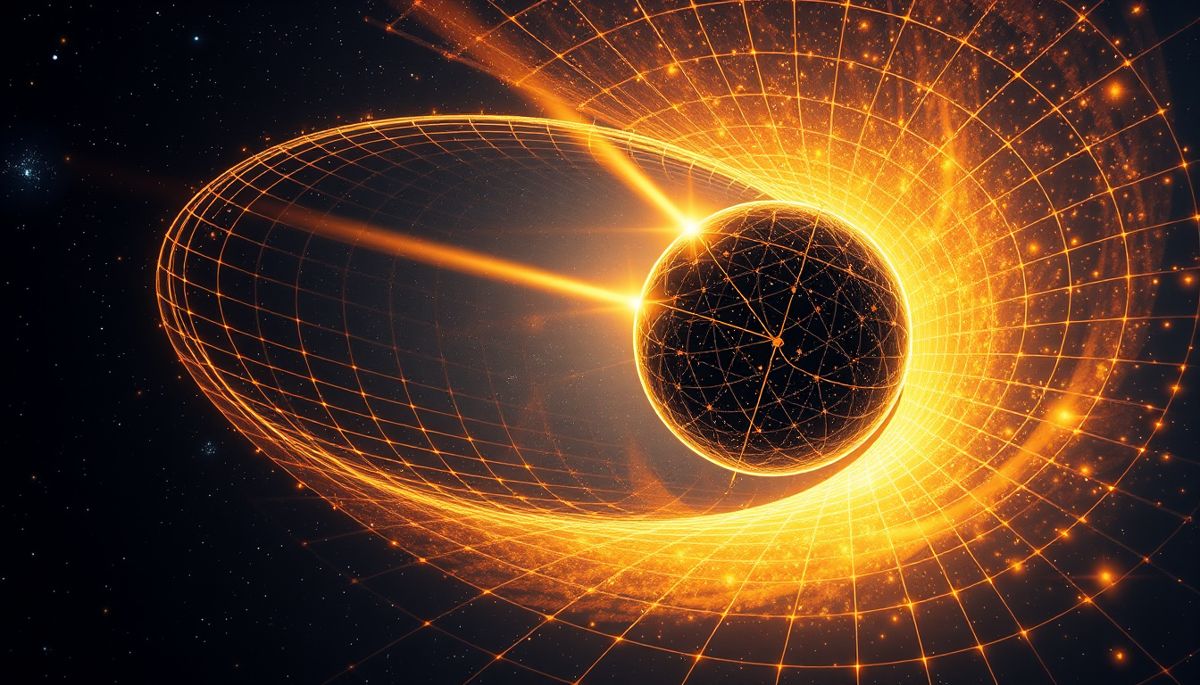
Special relativity left a loose thread: it couldn’t handle gravity. Einstein pulled on it for ten more years, guided by what he called the happiest thought of his life - that a person in free fall feels no gravity at all. In 1915 he published general relativity. Gravity, he said, is not a force reaching across empty space, as Newton had it. Instead, mass and energy bend the fabric of spacetime, and objects simply follow the curves. The Earth orbits the Sun not because it is pulled, but because the Sun has dented the geometry around it, and the Earth rolls along the slope. And, unlike most grand ideas, it made a hard prediction: starlight grazing the Sun should bend by a precise amount. All it needed was an eclipse to prove it.

The idea, in plain words

Picture spacetime as a taut sheet; a heavy ball (the Sun) sinks into it, and a passing marble curves around the dip. That’s gravity as geometry. The analogy leaks - real curvature is mostly in time - but it captures the idea: matter tells space how to bend, and space tells matter how to move.
The Eclipse That Made a Star
04

The Eclipse That Made a Star

0:00

1919 - overnight, the most famous mind on Earth.

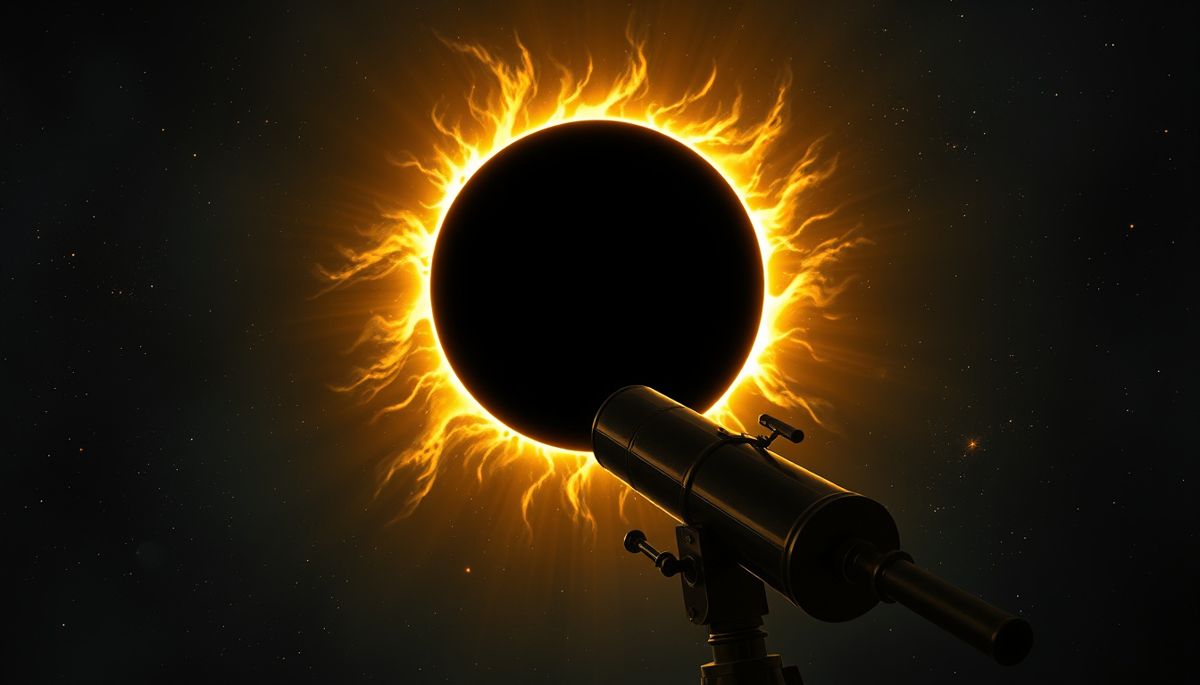
On May 29, 1919, the British astronomer Arthur Eddington aimed his cameras at a total solar eclipse from the island of Príncipe, off West Africa. With the Sun’s glare blotted out, he photographed the stars beside it and measured whether their light had bent by exactly Einstein’s predicted amount. It had. When the result was announced that November, the press lost its mind: ‘Revolution in Science,’ declared The Times of London; ‘Lights All Askew in the Heavens,’ gasped The New York Times. A German Jew’s theory, confirmed by an English Quaker just after a war that had set their nations against each other, became a symbol of science transcending borders. Two years later he won the Nobel Prize - but, in a famous twist, for the photoelectric effect, not relativity, which some still found too radical to certify.
God Does Not Play Dice
05

God Does Not Play Dice

0:00

The war he fought with the future he helped build.

Einstein helped father quantum theory - his photon paper was a cornerstone - and then spent the rest of his life at war with where it led. The new quantum mechanics said that, at the smallest scales, nature is irreducibly random: you can know the odds, never the certainty. Einstein recoiled. ‘He does not roll dice,’ he wrote of God to his friend Max Born in 1926. Through the famous Solvay debates he hurled thought experiments at Niels Bohr, trying to prove the theory incomplete; Bohr parried each one. In 1935, with Podolsky and Rosen, he flagged the ‘spooky action at a distance’ of entanglement as proof something was missing. Decades after his death, experiments settled it: nature really is that strange, and Einstein was wrong. But his objections forced physics to be precise - and seeded the science now behind quantum computing.
Exile
06

Exile

0:00

1933 - the world’s most famous refugee.

In 1933, while Einstein was visiting America, Adolf Hitler took power. As the world’s most famous Jew and a loud pacifist, Einstein was a marked man: the Nazis seized his property, burned his books, published a volume titled ‘100 Authors Against Einstein,’ and a magazine ran his photo captioned ‘not yet hanged.’ He never set foot in Germany again. He renounced his citizenship a second time and settled at the new Institute for Advanced Study in Princeton, New Jersey, living in a modest house, often sockless, ambling to work past students who could scarcely believe who passed. He used his fame to help other refugees escape, signing affidavits and raising funds. The boy who fled Prussian schoolrooms had become a refugee in earnest - and a conscience for the displaced.
The Letter and the Bomb
07

The Letter and the Bomb

0:00

1939 - a signature he came to regret.

In the summer of 1939, the physicist Leó Szilárd brought Einstein a terrifying possibility: a nuclear chain reaction could build a bomb of unimaginable power - and Nazi Germany might get there first. Szilárd drafted a letter to President Roosevelt; Einstein, whose name carried the weight of the world, signed it. That letter helped set in motion what became the Manhattan Project. Yet Einstein never worked on the bomb - the U.S. Army deemed the pacifist a security risk and denied him clearance. When Hiroshima was destroyed in 1945, he was devastated. He later called signing the letter ‘the one great mistake in my life,’ explaining he had done it only because the danger of Germany succeeding seemed real. He spent his final years campaigning against the weapon he had helped unleash, signing the Russell–Einstein Manifesto days before he died.
The Conscience of a Century
08

The Conscience of a Century

0:00

Genius wielded as conscience.

Fame could have made Einstein comfortable and quiet. It made him louder. In segregated America he called racism ‘a disease of white people’ and refused to look away: he joined the NAACP, befriended Paul Robeson and W.E.B. Du Bois, and in 1946 went to the historically Black Lincoln University to receive a degree and teach. He defended civil liberties through the McCarthy years, urging intellectuals to refuse to cooperate with witch-hunts - which earned him a 1,400-page FBI file under J. Edgar Hoover, who suspected communism and found nothing. In 1952 the new state of Israel offered him its presidency; he declined, saying he knew ‘a little about nature and hardly anything about men.’ He died in Princeton in 1955, refusing surgery, calling it ‘tasteless to prolong life artificially.’ A pathologist removed his brain without permission - but the better legacy is the one he chose: genius spent in the service of conscience.
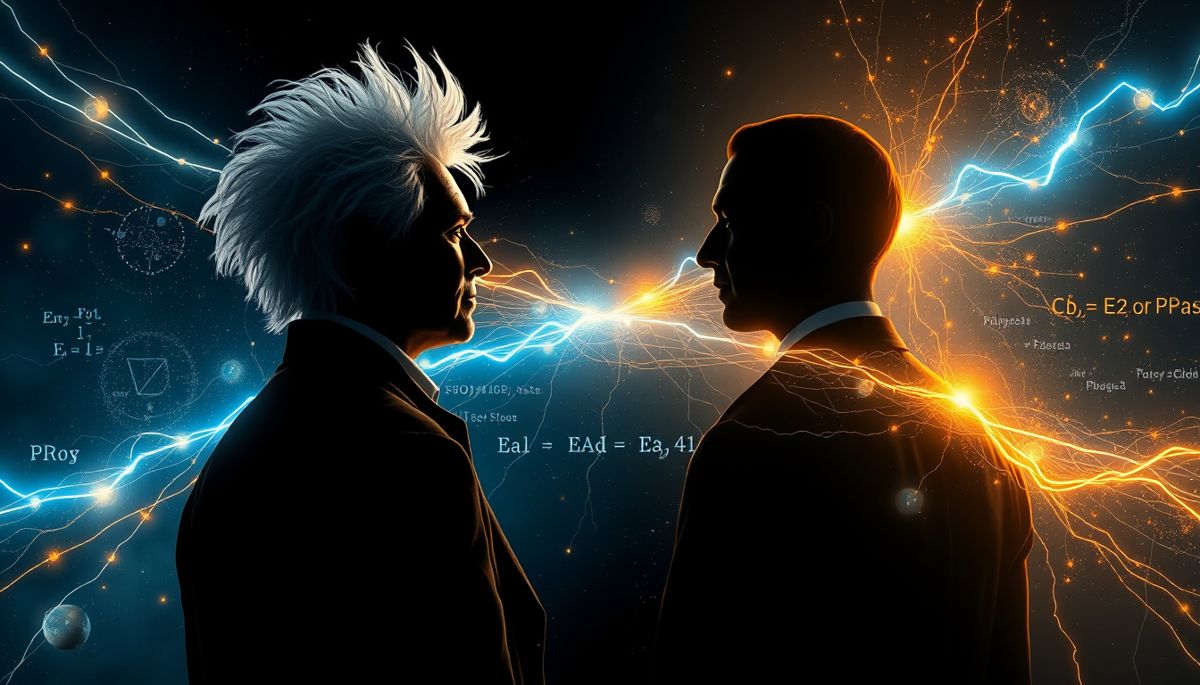
Tesla & Einstein: Two Currents
09

Tesla & Einstein: Two Currents

0:00

The other half of the story.

They were the two most famous scientific minds of their age, living barely fifty miles apart - Einstein at Princeton, Nikola Tesla in his Manhattan hotel - and yet, as far as any record shows, they never met. They touched only on paper. In 1931, for Tesla’s 75th birthday, Einstein sent a gracious note hailing him as ‘an eminent pioneer in the realm of high-frequency currents.’ Tesla did not return the warmth: he publicly ridiculed Einstein’s relativity as ‘a beggar clothed in purple,’ clinging to the old idea of a luminous ether that Einstein had swept away. One man saw the cosmos as waves in a medium; the other dissolved the medium and bent space itself. And that beloved line where Einstein supposedly called Tesla the smartest man alive? Pure myth - it appears in no record of either man. Two currents, alternating and relative, lighting one century without ever quite touching. (Tap Tesla in the map above to revisit Volume I.)

Sorting Fact From Legend

Myths & Misconceptions

No scientist is more mythologized. Here are the big claims - each with what the evidence actually says. Tap to reveal the reality.

Behind the Halo

The Human Einstein

The icon was also a sockless, violin-playing, sailing-but-can’t-swim refugee with a wicked sense of humor.

Einstein portrait
E=mc²

The most famous equation on Earth belonged to a man who wouldn’t wear socks, gave away his Nobel money, and turned down a country’s presidency. The cards below are flagged by how well each is documented.

No socks

‘When I was young,’ he explained, ‘I found the big toe always ends up making a hole in a sock - so I stopped wearing socks.’ Even at formal events.

his own words
The violin, ‘Lina’

He played Mozart to think, and credited music with helping him reason through problems.

told by friends
Sailed, couldn’t swim

He sailed all his life for the joy of it - though he never swam well and often had to be helped back to shore.

told by friends
Stateless by choice

He renounced German citizenship at 16, spent years stateless, became Swiss, then American in 1940 - never quite belonging to one flag.

told by friends
The tongue

The famous tongue-out photo was snapped on his 72nd birthday in 1951; he loved it so much he ordered prints for friends.

told by friends
He gave away the Nobel

In his divorce from Mileva he promised her the money from a Nobel he hadn’t yet won - and made good on it years later.

told by friends
‘Hardly anything about men’

Offered Israel’s presidency in 1952, he declined: he knew ‘a little about nature,’ he said, ‘and hardly anything about men.’

verified
The wandering brain

After he died, a pathologist removed his brain without family consent and kept it for over 40 years, mailing slices to researchers.

told by friends

Einstein wore his genius lightly - sockless, violin in hand, allergic to pomp. Some of these are in his own words; others come down through friends and photographers, so we have flagged which is which.

A Life in Light

A Timeline

From a compass in Munich to a manifesto against the bomb. Filter the threads.

March 14, 1879
Life

Born in Ulm, Germany, into a secular Jewish family; raised in Munich.

c. 1884
Life

His father shows him a compass; the invisible force moving the needle awakens his lifelong wonder.

1895
Life

At 16 he fails the general section of the ETH Zurich entrance exam - but aces math and physics.

1896
Life

Renounces German citizenship; enters the Zurich Polytechnic.

1900
Life

Graduates - and cannot find an academic post.

1902
Life

Becomes a patent clerk in Bern; his daughter Lieserl is born (her fate unknown).

1905
Science

The miracle year: photoelectric effect, Brownian motion, special relativity, and E=mc².

1915
Science

Completes general relativity - gravity as curved spacetime.

May 29, 1919
Fame

Eddington’s eclipse confirms light-bending; Einstein becomes a global celebrity.

1921
Fame

Awarded the Nobel Prize in Physics - for the photoelectric effect, not relativity.

1933
Exile

Flees Nazi Germany; settles at the Institute for Advanced Study in Princeton.

1935
Quantum

The EPR paper challenges quantum theory’s completeness (‘spooky action at a distance’).

Aug 2, 1939
The Bomb

Signs the Szilárd-drafted letter warning Roosevelt that Germany might build an atomic bomb.

1940
Exile

Becomes a U.S. citizen (keeping his Swiss citizenship).

Aug 1945
The Bomb

Hiroshima; Einstein, who never worked on the bomb, is devastated.

1946
Conscience

Calls racism ‘a disease of white people’; visits Lincoln University.

1952
Conscience

Declines the offered presidency of Israel.

Apr 11, 1955
Conscience

Signs the Russell–Einstein Manifesto against nuclear war - days before his death.

Apr 18, 1955
Conscience

Dies in Princeton at 76; his brain is removed without permission.

1921 letter
Tesla

Einstein’s 1931 birthday note to Tesla remains the only documented contact between the two giants.

In His Words (Allegedly)

Quotes, Fact-Checked

Einstein is the most misquoted person alive. Every line here is tagged by how well it holds up.

Verified
“Imagination is more important than knowledge. For knowledge is limited, whereas imagination embraces the entire world.”
Albert EinsteinOn creativity, in a 1929 interview.Saturday Evening Post interview (G. S. Viereck), 1929.
Verified
“I, at any rate, am convinced that He does not roll dice.”
Albert EinsteinRejecting quantum randomness, to Max Born.Letter to Max Born, 1926 (The Born-Einstein Letters).
Reported by a biographer
“Signing that letter to Roosevelt was the one great mistake in my life.”
Albert EinsteinOn the 1939 atomic-bomb letter.Reported to Linus Pauling, 1954 (Pauling’s diary).
Verified
“As an eminent pioneer in the realm of high frequency currents... I congratulate you on the great successes of your life’s work.”
Albert EinsteinHis note for Tesla’s 75th birthday.1931; partial text, Tesla Memorial Society.
Verified
“Racism is a disease of white people, and I do not intend to be quiet about it.”
Albert EinsteinOn American segregation (paraphrase of his argument).‘The Negro Question,’ Pageant magazine, 1946.
Apocryphal - not true
“Two things are infinite: the universe and human stupidity; and I’m not sure about the universe.”
Albert Einstein (attributed)A favorite internet zinger.No source in his writings - apocryphal.
Apocryphal - not true
“Compound interest is the eighth wonder of the world.”
Albert Einstein (attributed)Beloved by finance bros everywhere.No evidence Einstein said it - apocryphal.
Apocryphal - not true
“Everybody is a genius. But if you judge a fish by its ability to climb a tree, it will live its whole life believing it is stupid.”
Albert Einstein (attributed)Ubiquitous on motivational posters.No evidence Einstein said it - apocryphal.
Apocryphal - not true
“Insanity is doing the same thing over and over again and expecting different results.”
Albert Einstein (attributed)Endlessly repeated as his.Traced to a 1981 Al-Anon pamphlet, not Einstein.
Apocryphal - not true
“When asked how it feels to be the smartest man alive, Einstein said: I don’t know, you’ll have to ask Nikola Tesla.”
Albert Einstein (attributed)The viral Tesla-Einstein quote.No primary source anywhere - apocryphal.
The Internet’s Favorite Sage

Did He Really Say That?

Five quotes the internet swears are Einstein’s - and one about him. Tap each card.

“QUOTE”

‘Insanity is doing the same thing over and over...’

did he say it? tap ☀
THE TRUTH

Not Einstein. The line first appears in a 1981 Al-Anon pamphlet - decades after his death.

“QUOTE”

‘Everyone is a genius. But if you judge a fish by its ability to climb a tree...’

did he say it? tap ☀
THE TRUTH

No evidence Einstein ever said it - a lovely thought with no link to him.

“QUOTE”

‘Compound interest is the eighth wonder of the world.’

did he say it? tap ☀
THE TRUTH

Apocryphal - it surfaces in mid-century advertising, never in anything Einstein wrote.

“QUOTE”

‘If the bee disappeared, man would have four years left to live.’

did he say it? tap ☀
THE TRUTH

That’s closer to Maurice Maeterlinck’s book on bees - not Einstein at all.

“QUOTE”

‘Einstein failed math.’

did he say it? tap ☀
THE TRUTH

False. He mastered calculus by 15 and topped his class; he failed the language part of one entrance exam.

“QUOTE”

‘Einstein called Tesla the smartest man alive.’

did he say it? tap ☀
THE TRUTH

Apocryphal - the same fake quote that haunts Volume I. No record of it exists.

The Web of Connections

Who Einstein Connects To

The series grows by links. Tesla is highlighted in electric blue - tap him to jump back to Volume I.

TESLABohrNewtonCuriePlanckGodelSzilardEINSTEIN

Einstein admired Tesla on paper; Tesla mocked Einstein in the press. Two giants, one century, never in the same room. The vector database now holds both - so it can trace the threads between them on its own.

☀ Powered by AI

Ask the Archive

Curious about something the chapters didn’t cover? Ask, and the storybook’s AI will dive deeper using the researched archive.

Receipts

Sources

Researched and cross-checked across these references.

Ambient score