
Alan Turing
He invented the abstract idea of a computer to answer a math problem, helped break the codes that shortened a world war, and was chemically punished by the same country he'd helped save for who he loved.
Alan Turing was an English mathematician who, in a single 1936 paper, defined the theoretical foundation of every computer built since. During WWII he helped break German Enigma codes at Bletchley Park, work credited with shortening the war by years. In 1952 he was prosecuted and chemically castrated for being gay; he died in 1954, officially ruled a suicide, though real historical debate remains over that finding.

Sherborne
Born June 23, 1912, in London, Turing attended Sherborne School in Dorset from 1926 to 1931. Teachers there prized classics over his natural pull toward math and science, but he still won a string of school mathematics prizes. At Sherborne he formed an intense friendship with fellow student Christopher Morcom, who pushed him toward academic ambition. Morcom died suddenly of tuberculosis in 1930 — a loss that devastated Turing and, by many biographers' accounts, shaped his lifelong interest in mind, thought, and what survives a person.
English public schools of the 1920s were built around classical education; a student whose real gift was mathematics had to develop it largely against the grain of the institution around him, through prize competitions rather than curriculum.
On Computable Numbers
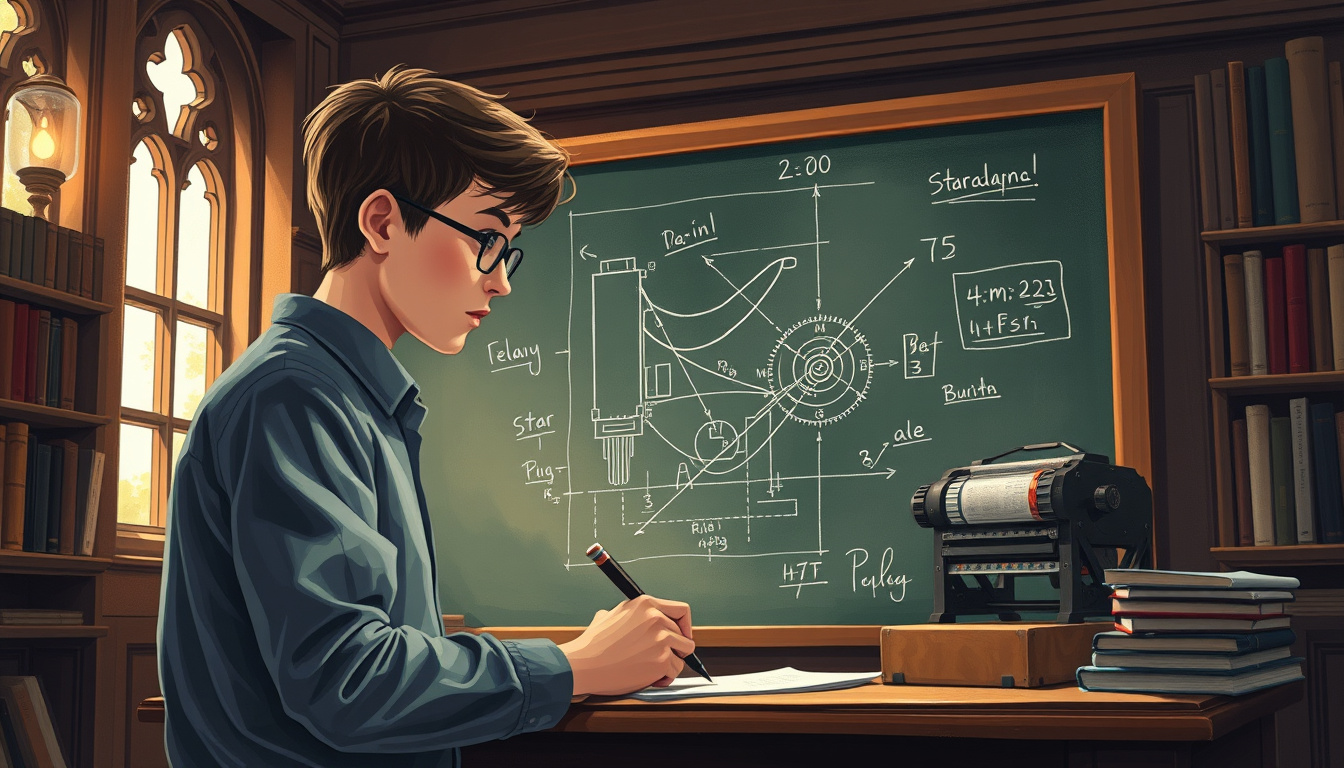
Turing matriculated at King's College, Cambridge in 1931, graduated in 1934 with a distinguished mathematics degree, and became a Fellow in 1935. In 1936, at just 23, he published 'On Computable Numbers, with an Application to the Entscheidungsproblem' — a 36-page paper describing an imaginary tape-reading machine to resolve an abstract question in mathematical logic. In doing so, he had, almost as a side effect, defined for the first time what a computer is and what it means for something to be computable.
Turing's 'a-machine' was purely a thought experiment: an infinite tape, a read/write head, and a finite set of rules — simple enough to reason about mathematically, yet powerful enough to describe any computation, a property no one had ever precisely defined before.
The Church-Turing Thesis
Turing traveled to Princeton in September 1936 to study directly under Alonzo Church, the American logician who had independently reached an equivalent conclusion via his own lambda calculus. Turing added an appendix proving the two systems were mathematically equivalent — a convergence now called the Church-Turing thesis. He completed his PhD at Princeton in 1938. It was Church who gave Turing's abstract 'a-machine' the name it has carried ever since: the Turing machine.
Two mathematicians on opposite sides of the Atlantic, working through entirely different formal systems, arrived at the same boundary of what's computable — strong independent evidence that the boundary they'd found was a real, fundamental one, not an artifact of either man's particular notation.

Bletchley Park
Turing was recruited to Britain's Government Code and Cypher School at Bletchley Park and became heavily involved in the attack on German naval Enigma traffic — considered the hardest and most operationally critical Enigma variant to break, since naval codes protected the U-boat convoys threatening Britain's Atlantic supply lines.
Enigma scrambled messages through a combination of rotating wheels and a plugboard that could be configured in an astronomical number of ways each day — brute-force guessing was mathematically hopeless within any useful timeframe, which is exactly the kind of constraint Turing's theoretical training was suited to attack differently.
The Bombe
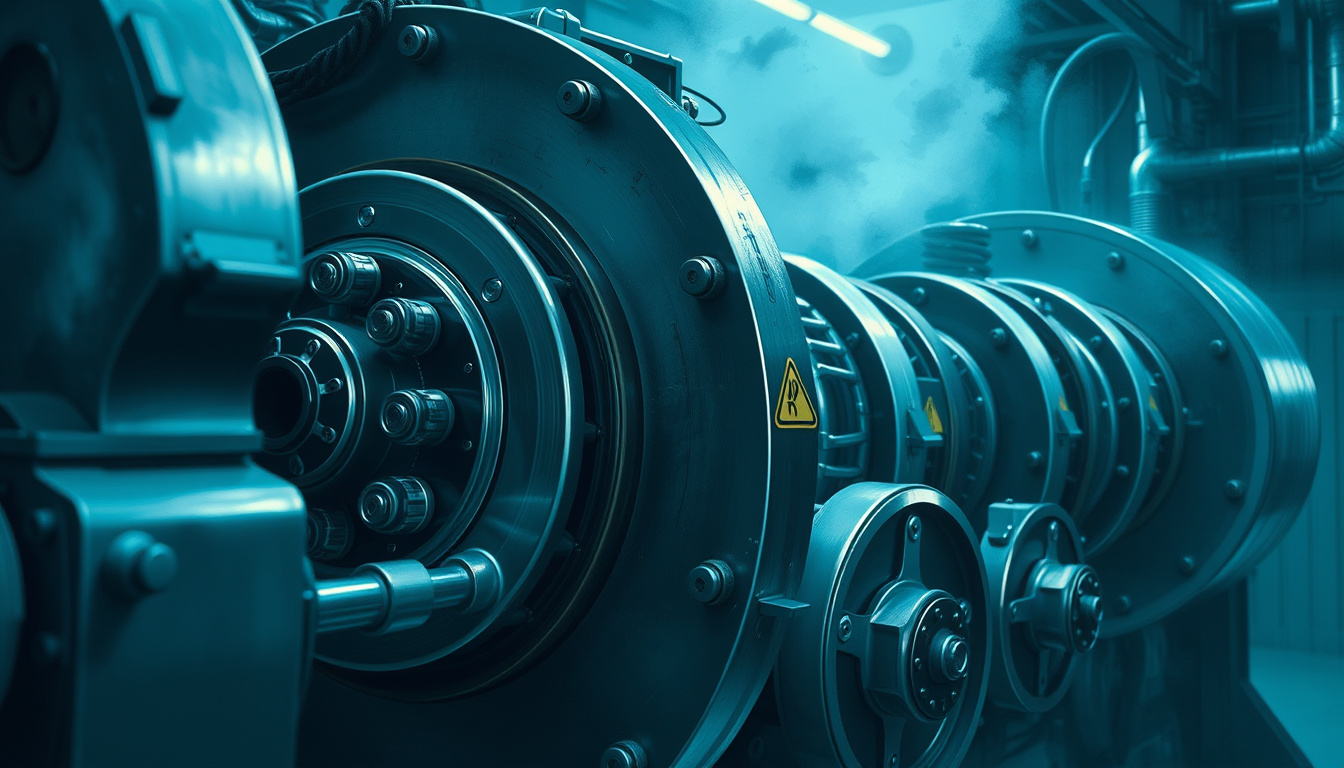
Turing designed the Bombe, an electro-mechanical device that, refined with Gordon Welchman's 'diagonal board' addition, could eliminate huge swaths of impossible Enigma settings through logical deduction rather than brute-force testing. From 1940 onward, Bombe-driven Enigma breaks produced intelligence at a volume unprecedented in military history. Historians commonly estimate this work shortened the war by two to four years, saving countless lives — a widely cited estimate, not a precisely documented figure.
Instead of testing every possible rotor and plugboard setting, the Bombe used known or guessed fragments of plaintext ('cribs') to logically rule out entire families of settings at once, turning an impossibly large search into a tractable one.

From Idea to Machine
After the war, Turing worked on the design of the ACE (Automatic Computing Engine) at the National Physical Laboratory, then moved to the University of Manchester, where one of the world's first working stored-program electronic computers was being built. He had spent the 1930s defining computation in the abstract; now he was helping build physical machines that actually did it.
The leap from the Turing machine (a theoretical tape-and-rules device) to real vacuum-tube hardware required solving entirely new engineering problems — memory, reliability, speed — that his 1936 paper had never needed to address.
Two Papers, Two Fields
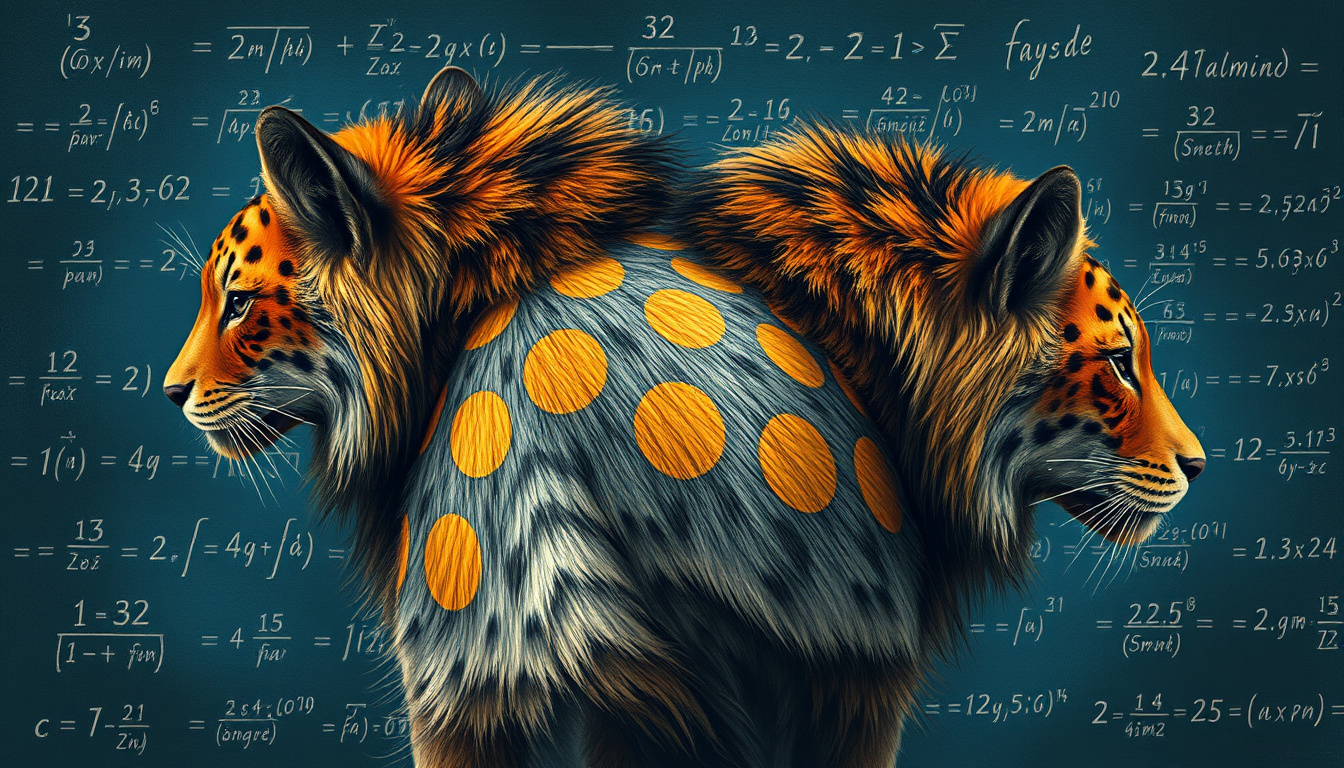
In 1950, Turing published 'Computing Machinery and Intelligence,' proposing what he called the 'imitation game' — now known as the Turing Test — as a practical way to sidestep the ill-defined question 'Can machines think?' Just two years later, in a completely different field, he published 'The Chemical Basis of Morphogenesis,' proposing a mathematical model for how patterns like spots and stripes spontaneously emerge in biological development — ideas now called Turing patterns, decades ahead of their time in mathematical biology.
Rather than trying to define 'thinking,' the Turing Test asks a narrower, testable question: can a human conversing by text tell a machine apart from another human? That reframing from an unanswerable philosophical question to a measurable one is the paper's real innovation.
Gross Indecency
In 1952, after reporting a burglary at his home, a police investigation revealed Turing's relationship with 19-year-old Arnold Murray. He was charged with 'gross indecency' under an 1885 law and given a choice between prison and probation conditional on hormonal treatment. He chose the hormone injections — synthetic oestrogen, commonly described as chemical castration — which caused physical side effects including impotence. The conviction also cost him his security clearance, ending his ability to continue government consulting work.
The 1885 statute Turing was prosecuted under was the same one used decades earlier against Oscar Wilde — a law that made consensual sexual activity between men a criminal offense in Britain until 1967.

The Apple and the Pardon
On June 8, 1954, Turing was found dead with a partially eaten apple beside him; the coroner ruled the cyanide-poisoning death a suicide, though the apple itself was never tested, and real historical debate persists — his mother maintained he may have accidentally inhaled cyanide fumes from home chemistry experiments, and some historians note he was reportedly in good spirits and making future plans at the time. He received a posthumous royal pardon in 2013, and in 2017 the UK passed 'Turing's Law,' retroactively pardoning thousands of others convicted under the same statute. In 2021, his 109th birthday, the Bank of England put him on the £50 note.
The popular belief that Apple Inc.'s bitten-apple logo is a tribute to Turing's death is a myth logo designer Rob Janoff has explicitly and repeatedly denied — the bite exists purely so the shape reads as an apple, not a cherry, at small sizes.
Timeline
Quotes
“It seems probable that once the machine thinking method had started, it would not take long to outstrip our feeble powers.”
Source: Multiple period sources, closely documented
“This is only a foretaste of what is to come, and only the shadow of what is going to be.”
Source: The Times, 1949; Bank of England £50 note
Myths & Reality
The Apple logo is a tribute to Turing's death
The bitten-apple Apple Inc. logo is widely believed to reference the apple found beside Turing's body.
Logo designer Rob Janoff has explicitly and repeatedly denied this, stating in 2009 'I'm afraid it didn't have a thing to do with it' — the bite exists so the shape reads as an apple rather than a cherry or tomato at small sizes.
The visual coincidence is real and the myth is understandable, but the connection has been directly and publicly denied by the person who actually designed the logo.
Turing's death was definitively a suicide
The coroner's ruling is often presented as settled historical fact.
The apple beside his body was never tested for cyanide, his mother maintained he may have accidentally inhaled cyanide fumes from his home chemistry experiments, and some historians note he was reportedly in good spirits and making future plans at the time of death.
Suicide remains the official ruling and a plausible explanation, but genuine, documented historical doubt exists rather than total certainty.
Turing's codebreaking is precisely measured as saving a specific number of lives
Tributes and articles often cite an exact-sounding figure for lives saved or years shaved off the war.
The commonly cited 'shortened the war by two to four years' figure is a historians' estimate based on the scale and timing of Enigma-derived intelligence, not a documented precise calculation.
The scale of the codebreaking's real impact is genuinely enormous and well supported; only the precision of any specific number is overstated in popular retellings.
Network
Click a name to jump to their story below.
Close school friend at Sherborne whose early death from tuberculosis in 1930 deeply affected Turing.
Princeton logician whose independently derived lambda calculus proved equivalent to Turing's machine-computability, forming the Church-Turing thesis; became Turing's PhD advisor.
Bletchley Park colleague whose 'diagonal board' addition to Turing's Bombe design dramatically improved its effectiveness.
19-year-old whose relationship with Turing led to the 1952 gross indecency investigation and conviction.
Granted Turing's posthumous royal pardon in 2013.
Apple Inc. logo designer who has explicitly and repeatedly denied any connection between the bitten-apple logo and Turing's death.
Character
Abstract-to-concrete range
Moved fluidly between pure theoretical abstraction (the 1936 Turing machine) and hands-on engineering (the Bombe, the ACE), rare across a single career.
Operational reframing of hard questions
Repeatedly turned unanswerable philosophical questions into testable, practical ones — most famously replacing 'Can machines think?' with the measurable imitation game.
Intellectual range across fields
Published landmark papers in three genuinely distinct fields — mathematical logic, artificial intelligence, and mathematical biology — each individually field-defining.
Quiet, sustained resolve under secrecy
Carried out years of classified, high-stakes codebreaking work that he could not discuss publicly, without public credit, during and long after the war.
Vulnerability to the era's prejudice
Was destroyed professionally and physically by 1950s Britain's criminalization of homosexuality despite being one of the nation's most valuable wartime assets.
Personal grief as intellectual fuel
Christopher Morcom's early death is widely linked by biographers to Turing's enduring fascination with mind, consciousness, and what persists after a person is gone.
Posthumous vindication over decades
It took nearly six decades after his death for Britain to formally pardon him — a legacy that arrived only long after his own lifetime could benefit from it.