
Jesse Owens
In eight days at Hitler's 1936 Olympics, a sharecropper's son from Alabama won four gold medals and put a very public dent in a regime's myth of racial supremacy. Then he went home to a country that wouldn't even send him a telegram.
Jesse Owens turned the 1936 Berlin Olympics — staged by Adolf Hitler's regime as a showcase of Aryan supremacy — into a personal repudiation of that ideology, winning four gold medals in the 100 meters, 200 meters, long jump, and 4x100 relay, several in world-record time. The popular story says Hitler snubbed him for it; the real, documented sequence is messier, and the sharper snub came from Owens's own country, where President Roosevelt never called and Owens had to enter his own honorary reception through a freight elevator. Stripped of his amateur status for refusing an unpaid exhibition tour, he spent years racing horses and cars for prize money just to get by, decades before America's highest civilian honors finally caught up with him. His long jump world record outlasted his competitive career by 25 years. The myth about who really snubbed him outlasted the truth even longer.

Cotton Fields to Cleveland
James Cleveland Owens was born September 12, 1913, in Oakville, Alabama, the last of ten children born to sharecroppers Henry and Mary Emma Owens, both children of formerly enslaved people. He was a sickly child — pneumonia recurred through the winters, and at five a fibrous growth on his chest swelled painfully; unable to afford a doctor, his mother cut it out herself with a sterilized kitchen knife. In 1922, part of the Great Migration, the family rode a train to Cleveland, Ohio, chasing factory wages and more freedom than Alabama allowed. There, a new teacher misheard the nine-year-old introduce himself as 'J.C.' and wrote down 'Jesse' instead. The name stuck for life.
Sharecropping bound Black families to landlords through crop debt rather than wages — a system built to resemble freedom while functioning like bondage. That structural trap, more than simple poverty, is what pushed roughly 1.5 million Black southerners north in the Great Migration, turning field laborers' children into future Olympians almost as a side effect of economics.

Riley's Second Father
At Fairmount Junior High, gym teacher and track coach Charles Riley noticed the frail transplant from Alabama and began training him before classes started, since Owens held after-school jobs and couldn't make regular practice. Riley, the son of a Pennsylvania mill worker, treated Owens like a second son, inviting him into his own home at a time of hard racial lines. By fifteen, Owens held national junior records in the high jump and long jump. Talent didn't guarantee the next step, though: at eighteen, competing for a spot in the 1932 Olympic trials, he lost in every event he entered. The breakthrough took another year.
Riley's real innovation was logistical, not technical: he moved practice to dawn, the one window a working-class Black teenager's schedule actually had open. That fix to a scheduling constraint, more than raw talent alone, is why Owens trained in relative obscurity for nearly a decade before anyone outside Cleveland took notice.
The Buckeye Bullet
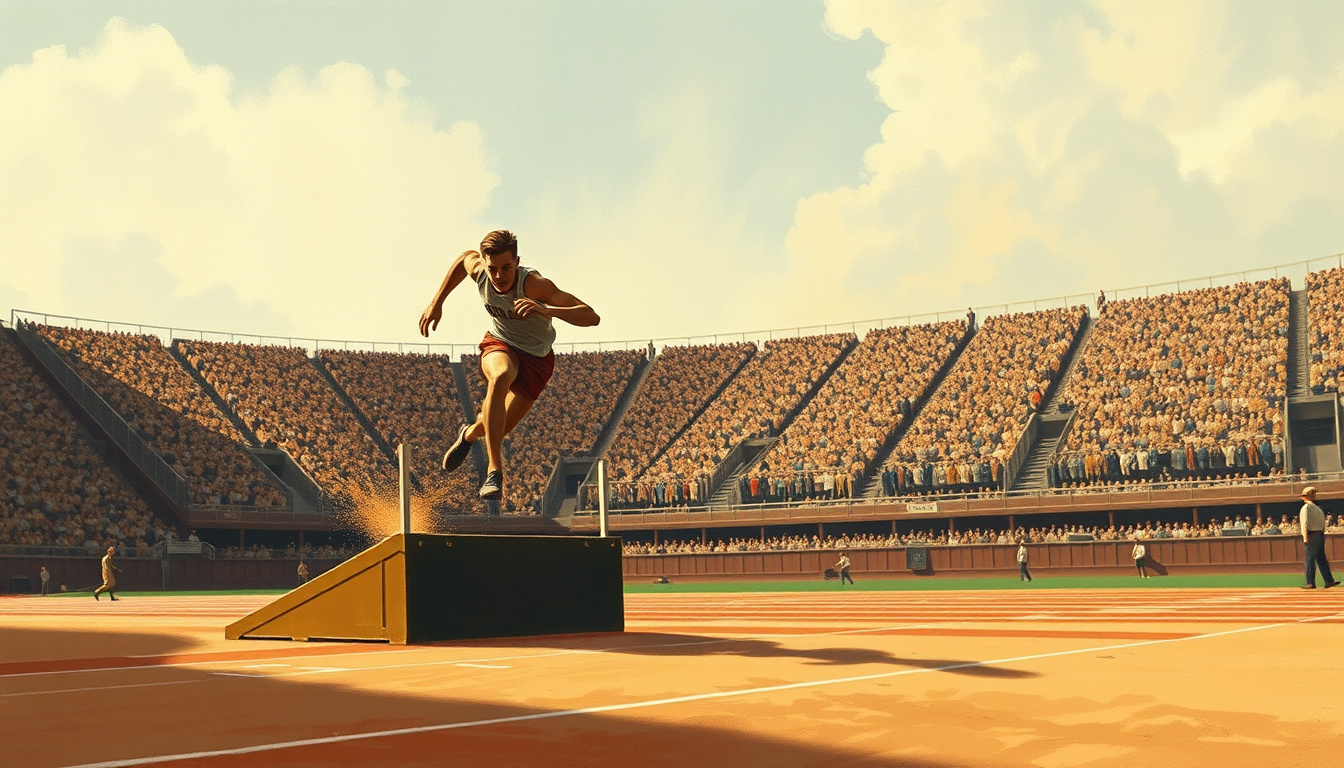
Owens enrolled at Ohio State in 1933 under a work-study arrangement running a freight elevator at the Statehouse; the university had no Black dormitory, so he shared a boarding house on East 11th Avenue and often couldn't eat or room with his own teammates on road trips. On May 25, 1935, at the Big Ten meet in Ann Arbor, Owens — nursing a sore back from a fall down stairs days earlier — tied the world 100-yard record, then over the next 45 minutes set outright world records in the long jump, 220-yard dash, and 220-yard low hurdles. Historians still call it the greatest single afternoon in track and field history.
Owens later said he warmed up gingerly, unsure his back would hold, and took just one clean attempt per event rather than risk a second — turning injury caution into economy of motion. The tight 45-minute window existed only because Big Ten scheduling crammed qualifying heats and finals into a single afternoon; an accident of logistics became the stage for the record.
Four Golds in Hitler's Berlin
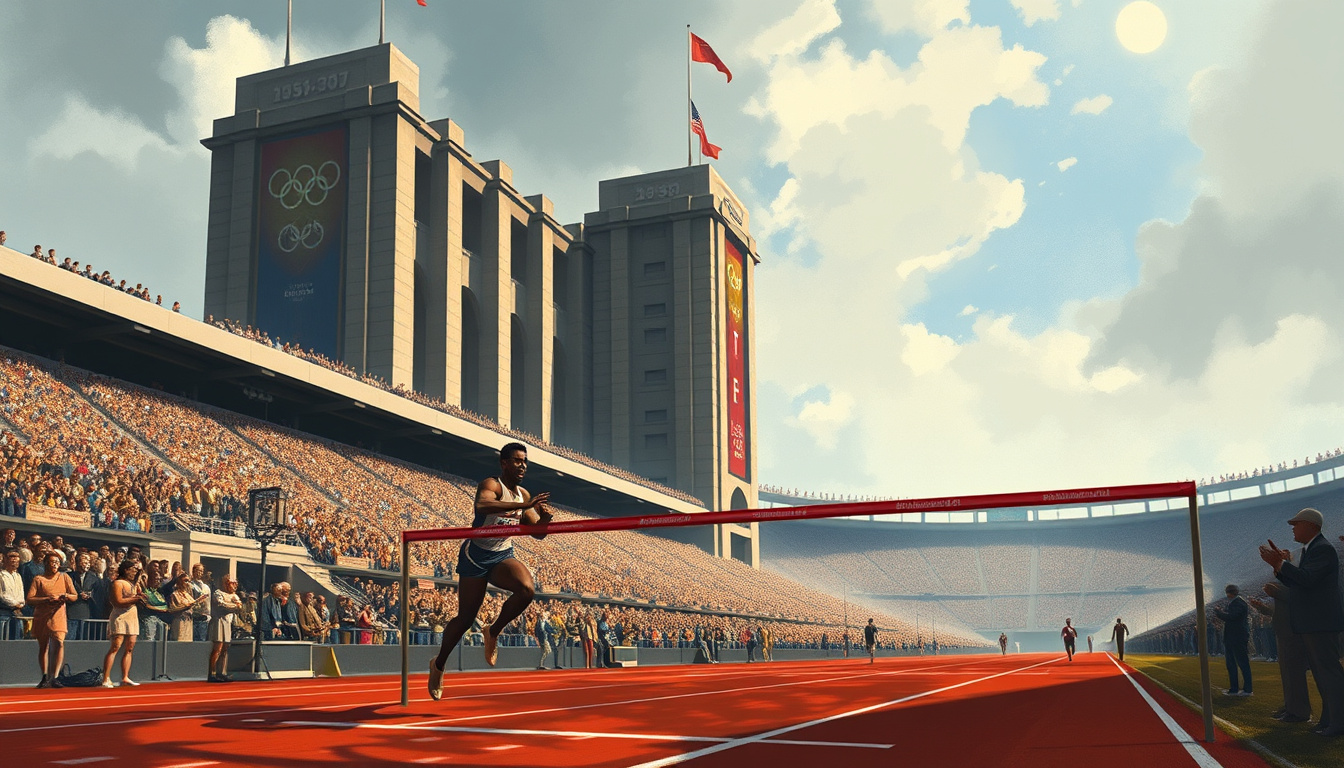
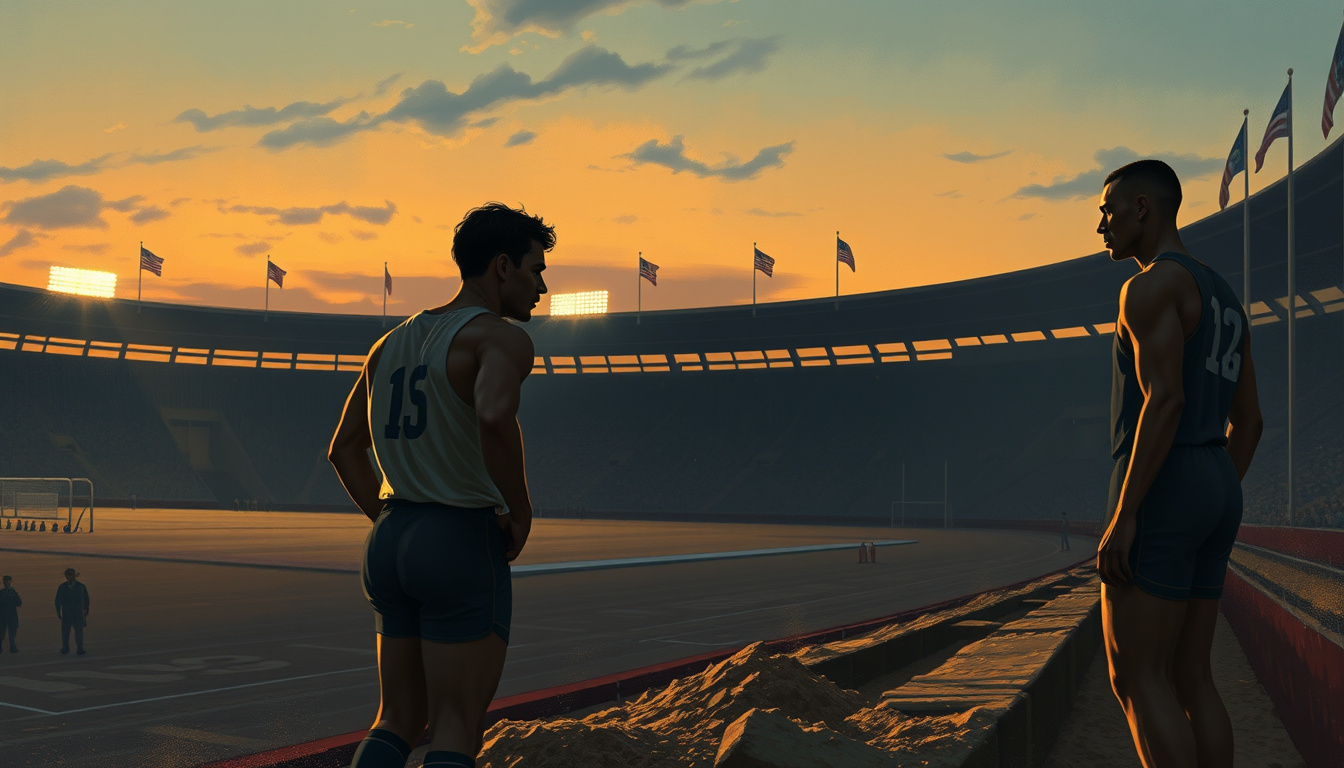
At the 1936 Berlin Games, staged by the Nazi regime as a showcase of Aryan supremacy, Owens won four gold medals in eight days: the 100 meters (10.3s), the long jump, the 200 meters (20.7s), and the 4x100 relay (39.8s, a world record). In the long jump, after nearly fouling out of qualifying, he got a tip on his takeoff mark from his chief rival, German jumper Luz Long — advice that helped him qualify, and then beat Long for gold. The two walked arm-in-arm from the stadium afterward as roughly 100,000 spectators, Hitler among them, watched. Contrary to later legend, the German crowd cheered Owens loudly throughout the Games.
Owens made the relay team partly because U.S. officials pulled two Jewish-American sprinters, Marty Glickman and Sam Stoller, from the lineup the day before — a decision historians now read as appeasement of the German hosts rather than pure meritocracy. His fourth gold medal was itself entangled in the Games' politics, not separate from them.
The Snub That Wasn't
The enduring legend says Hitler stormed out of the stadium rather than congratulate a Black gold medalist. The documented sequence is messier: Hitler shook hands with German winners on day one, was then told by Olympic officials to greet all winners or none, and afterward congratulated no one publicly — snubbing the Black American high jumper Cornelius Johnson on that first day, before Owens had even competed. Owens spent years insisting the popular story was wrong. Far less mythologized: President Franklin Roosevelt never sent Owens a telegram or a White House invitation, and no Black 1936 Olympian was invited. 'Hitler didn't snub me,' Owens said later. 'It was our president who snubbed me.'
American newsreels and papers needed a clean foreign villain, and a hostile dictator refusing a Black hero's handshake made a tidier story than an uncomfortable truth about domestic segregation. The myth displaced blame outward, letting the closer-to-home snub go largely unexamined for decades.
Freight Elevator, Fast Money
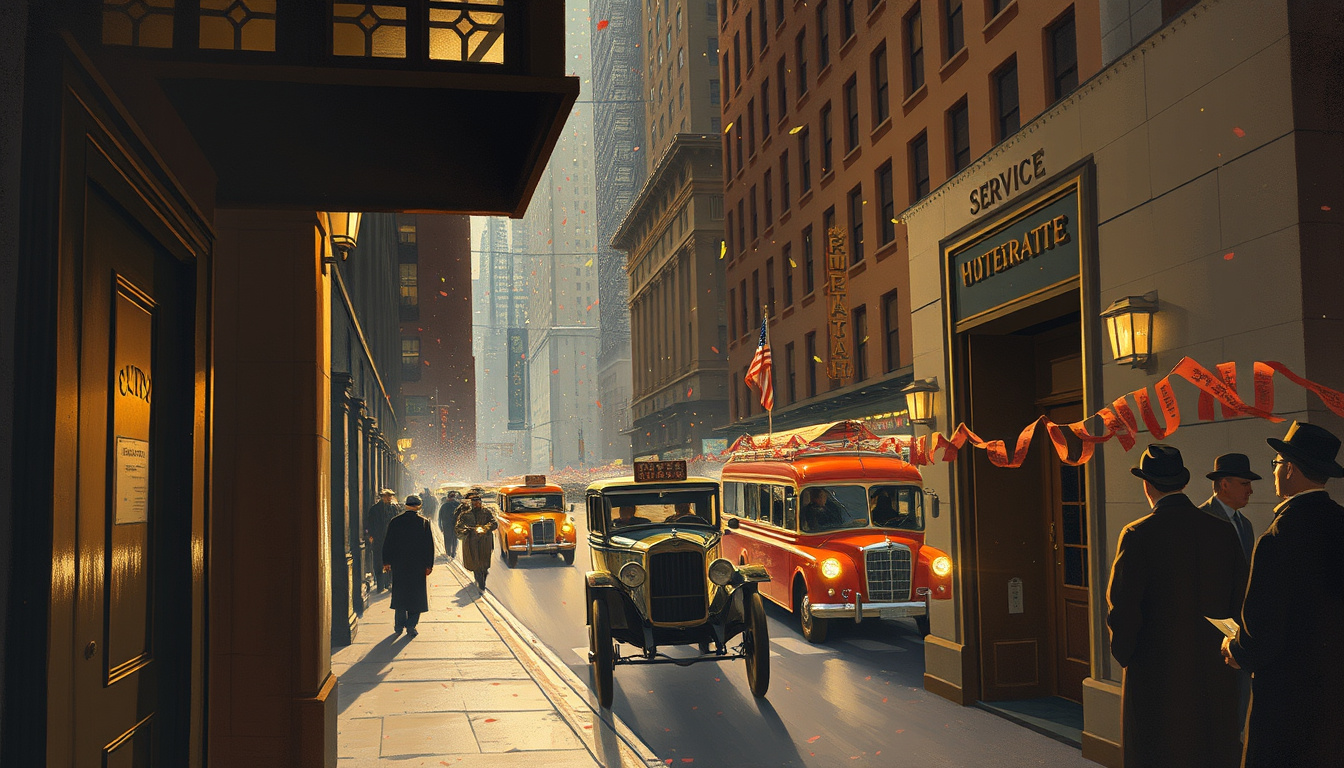
New York gave Owens a ticker-tape parade on his return — then routed him to a freight elevator to reach his own reception at the segregated Waldorf-Astoria, which barred Black guests from the front entrance. Weeks later, after Owens refused to continue an unpaid European exhibition tour the AAU had booked him on, officials led by Avery Brundage stripped his amateur eligibility, closing off any path to further competition. Within months, the fastest man alive was working as a gas station attendant and playground janitor, and racing for money against motorcycles, cars, and racehorses, given a head start and outrunning them for a purse.
Amateur-status rules of the era existed to keep Olympic athletes financially dependent on federations like the AAU rather than the open market — so refusing an unpaid tour wasn't just insubordination, it broke the exact leverage the AAU held over him. Racing animals and machines was one of the few legal ways left for a banned 'amateur' to get paid to run.

Blackthink and the Fist
By the late 1960s Owens had become a corporate speaker and unofficial ambassador for American sport — and a target of a younger generation's frustration. When Tommie Smith and John Carlos raised gloved fists on the medal stand at the 1968 Mexico City Olympics, Owens publicly condemned the gesture. His 1970 memoir, 'Blackthink,' laid out that criticism at length — including the line that the raised fist was 'a meaningless symbol' — doubling down on separatist politics and drawing fierce criticism from civil rights activists. Two years later, in 'I Have Changed,' Owens revised his position, acknowledging he'd misjudged the moment and underestimated the anger behind the protest.
Owens had built his post-Olympic livelihood on being palatable to white corporate and political audiences — the same institutions that had once frozen him out now paid him precisely because he wasn't confrontational. That financial dependency shaped his public politics as much as personal conviction did, until public backlash forced a reckoning.
The Final Lap
In 1976, President Gerald Ford awarded Owens the Presidential Medal of Freedom — a symbolic, decades-late close to the Roosevelt silence. But Owens, a smoker for more than three decades, was diagnosed with inoperable lung cancer in late 1979. He underwent radiation, chemotherapy, and an experimental drug regimen, hospitalized on and off for months. He died in Tucson, Arizona, on March 31, 1980, at age 66. In 1990, President George H.W. Bush posthumously awarded him the Congressional Gold Medal, making him one of only a handful of Americans to hold both of the nation's top civilian honors.
The same decades of barnstorming that kept Owens financially afloat after 1936 — constant travel, public appearances, cigarettes as social currency in mid-century America — quietly built the health toll that caught up with him at 66, a slower and less visible cost of the fame economy he'd been pushed into.
The Record Outlives the Myth
Owens's 1935 long jump world record stood unbroken for 25 years until Ralph Boston beat it in 1960; Owens told him simply, 'I'm just thankful that it stood up this long.' Streets in Berlin and dozens of American cities now carry his name, and Ohio State's track stadium and the U.S. Olympic and Paralympic Hall of Fame honor his image. But the Hitler-snub legend he spent his life trying to correct still outpaces the story he actually lived: a country that celebrated him with parades and, in the same breath, made him ride freight elevators, stripped his amateur status, and withheld a presidential handshake for twenty years.
A simplified villain-abroad story required no domestic reckoning, which is exactly why it outlasted the facts. Retelling 'Hitler snubbed Owens' cost American institutions nothing; retelling 'Roosevelt snubbed Owens' indicted them. Myths survive less because they're best documented than because no one in power has to answer for them.
Timeline
Quotes
“Hitler didn't snub me—it was our president who snubbed me. The president didn't even send me a telegram.”
“Friendships born on the field of athletic strife are the real gold of competition. Awards become corroded, friends gather no dust.”
“The black fist is a meaningless symbol. When you open it, you have nothing but fingers — weak, empty fingers. The only symbol I know is the American flag.”
“I'm just thankful that it stood up this long.”
Myths
The Hitler Snub
Enraged that a Black American had humiliated his 'master race' showcase, Hitler stormed out of the Olympic Stadium specifically to avoid shaking Jesse Owens's hand.
Hitler shook hands with German gold medalists on day one, then was told by Olympic officials he must greet every winner or none — after that he congratulated no one publicly. The Black American athlete he did visibly snub was high jumper Cornelius Johnson, on the first day, before Owens had even competed. Owens himself spent years trying to correct the story, and the German crowd cheered him loudly throughout the Games.
America Welcomed Him Home as a Hero
The story of the snub belongs entirely to Nazi Germany; Owens returned to a grateful, celebratory United States.
President Roosevelt never sent Owens a congratulatory telegram or a White House invitation — no Black 1936 Olympian received one. Owens had to enter his own celebratory reception at the segregated Waldorf-Astoria through a freight elevator, and he wasn't invited to the White House for nearly twenty years.
A Straightforward Civil Rights Hero
Owens is remembered as an uncomplicated civil-rights icon whose legacy flows smoothly into the movement that followed him.
In 1968, Owens publicly condemned Tommie Smith and John Carlos's Black Power salute — a position he laid out at length in his 1970 book 'Blackthink,' aligning with an older, more assimilationist strategy and drawing sharp criticism from younger Black athletes and activists. He partially reversed that stance in his 1972 book 'I Have Changed.'
Luz Long's Battlefield Letter
As he lay dying in Sicily in 1943, Luz Long wrote Owens a final letter asking him to find his son after the war and tell him about their friendship.
This poignant letter is repeated constantly in tribute articles and children's retellings, but biographers have not located verified primary documentation of its exact text or delivery. The broader friendship is well attested — Long did die fighting for Germany in Sicily in 1943, and the two families did reconnect decades later — but the specific deathbed-letter scene functions largely as embellishment layered onto real events.
Long's Advice Single-Handedly Saved the Gold Medal
Without Luz Long's spontaneous coaching tip, Owens would have fouled out of the long jump entirely and never won gold.
Long did offer Owens advice on his takeoff mark during a tense qualifying round, and Owens credited it for the rest of his life. But some retellings dramatize the exchange's exact wording and stakes beyond what contemporaneous sources fully confirm — a case where a real, generous gesture has been polished into a slightly cleaner legend over decades of retelling.
Network
Click a name to jump to their story below.
Fairmount Junior High's gym teacher trained Owens before school for nearly a decade, invited him into his own home across hard racial lines, and shaped the running form that carried him to Berlin.
Owens's junior-high girlfriend and mother of his first daughter three years before their 1935 wedding; his wife until his death in 1980.
German long jumper who advised Owens on his run-up mark during a tense qualifying round, then lost to him for gold and celebrated arm-in-arm anyway; killed fighting for Germany in Sicily in 1943, after which the two families stayed connected for decades.
President of the American Olympic Committee who approved pulling two Jewish-American sprinters from the relay to avoid embarrassing the German hosts, then presided over stripping Owens's amateur status months later.
Never sent Owens a congratulatory telegram or a White House invitation after Berlin — a silence Owens later said stung more than anything attributed to Hitler.
1968 Olympic sprinters whose raised-fist protest Owens condemned as 'meaningless,' a position he partly walked back four years later in print.
Fellow Black sprinter and Owens's closest domestic competitor through the mid-1930s, teammate on the 1936 relay, later a U.S. Congressman.
Staged the 1936 Games to showcase Aryan supremacy; the popular story of him personally refusing to shake Owens's hand is more myth than documented fact, though his regime did visibly snub another Black American medalist, Cornelius Johnson.
Character
Built for economy, not strain
His 10.3-second 100m and 20.7-second 200m at Berlin were models of unhurried, efficient form — contemporaries marveled that he looked relaxed even at world-record pace.
Understated under pressure
Despite reporters pushing him for years to dramatically denounce Hitler, Owens's public statements stayed measured; his sharpest criticism was reserved, pointedly, for the American president who never called.
Forged by early fragility
A childhood of recurring pneumonia and a kitchen-table surgery to remove a chest growth left him sickly into his teens; Charles Riley's disciplined pre-dawn training is what turned that frail body into the fastest in the world.
A showman when the medals stopped paying
Banned from amateur competition in 1936, he leaned into spectacle rather than disappear — racing motorcycles, cars, and racehorses across Cuba and the Midwest for prize money.
Politically cautious, then self-correcting
Publicly condemned the 1968 Black Power salute as 'meaningless' in line with an older assimilationist strategy, then reversed much of that position in his 1972 book 'I Have Changed' after fierce criticism.
Loyalty that crossed enemy lines
Stayed in touch with Luz Long's widow and son after Long died fighting for Germany in World War II, a bond both families still describe as central to their story generations later.
A relentless self-marketer
Rebuilt a career as a paid public speaker and as Ford Motor Company's director of minority employment, having learned exactly how to monetize being 'the Olympic hero' a country once refused to reward.
Have a question this chapter didn\u2019t answer? Ask the archive \u2014 answered live, checked against the same research as the story above.