
The Story in Nine Chapters
Wolfgang Amadeus Mozart was performing for European royalty before he could write his own name properly, and was dead of an undiagnosed illness at thirty-five, having produced over six hundred works in barely three decades of composing. Born in Salzburg to a musician father who recognized -- and relentlessly promoted -- his talent, he spent his childhood on tour instead of in a classroom, became a servant-employee of a prince-archbishop who treated him little better than kitchen staff, and finally broke free to Vienna, where he married for love, wrote the operas that still anchor the repertoire, joined the Freemasons, earned more money than almost anyone in his profession, and still managed to die in debt. What happened after his death did almost as much to shape his legend as anything he composed: an ordinary funeral got remembered as a pauper's burial, a professional rival got recast as a murderer, and a 1993 psychology study about college students got turned into a myth that his music makes babies smarter.
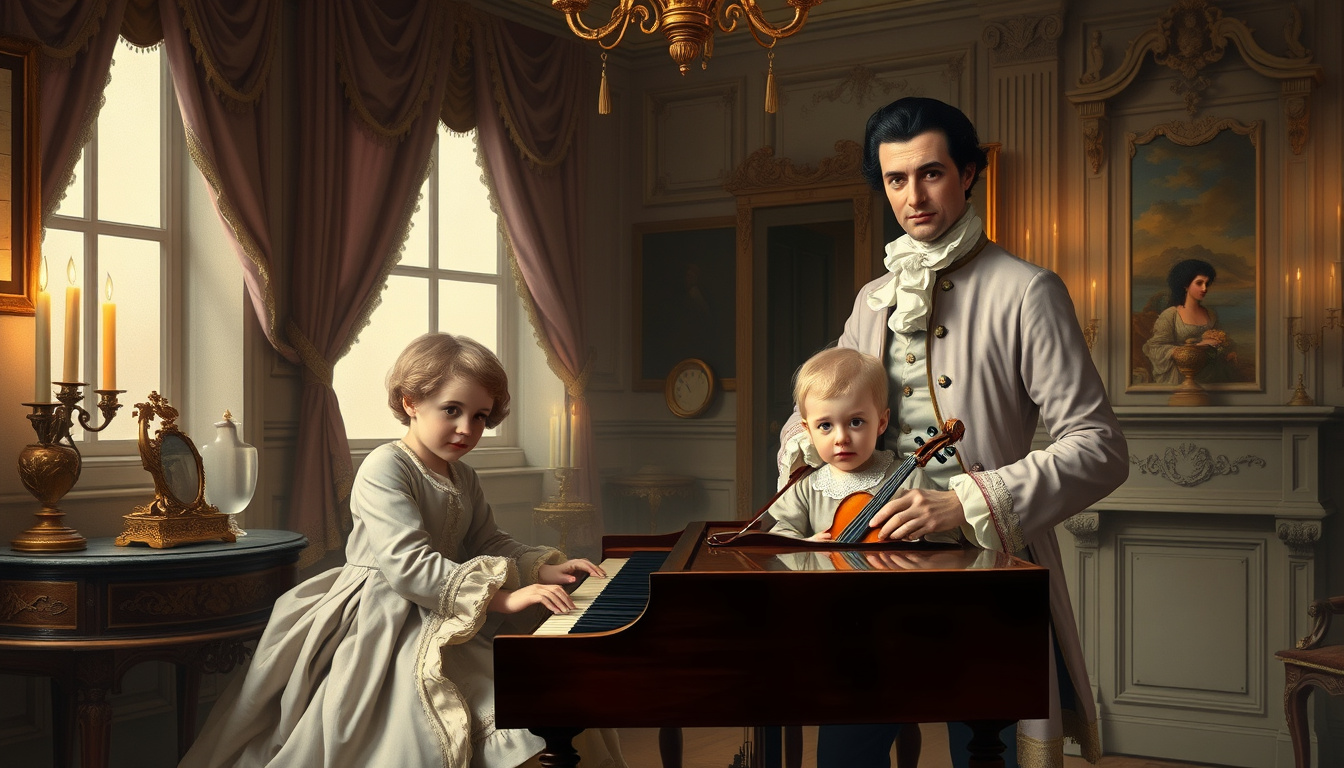
The Miracle of Salzburg
Wolfgang was born January 27, 1756, in Salzburg, and baptized the next day with a string of names -- Johannes Chrysostomus Wolfgangus Theophilus Mozart -- the first two taken from the saint's day of his birth. 'Theophilus,' Greek for 'lover of God,' would later be Latinized into the name the world actually remembers him by: Amadeus, a nickname he himself sometimes used as a joke in mock-Latin letter signatures, decades before it became his official-sounding public name. His father, Leopold Mozart, was a professional composer and violinist at the Salzburg court and an unusually skilled teacher, who gave up composing almost entirely once it became clear his son's gifts outstripped his own. By five, Wolfgang was competent on keyboard and violin and had begun composing on his own initiative, surprising Leopold with ink-spattered pieces nobody had assigned him. His older sister Maria Anna -- known in the family as Nannerl -- was every bit as precocious a performer, and the two children began appearing together at the Bavarian and Habsburg courts in 1762, launching a family business built on the astonishment of European aristocracy that children this young could play like this.
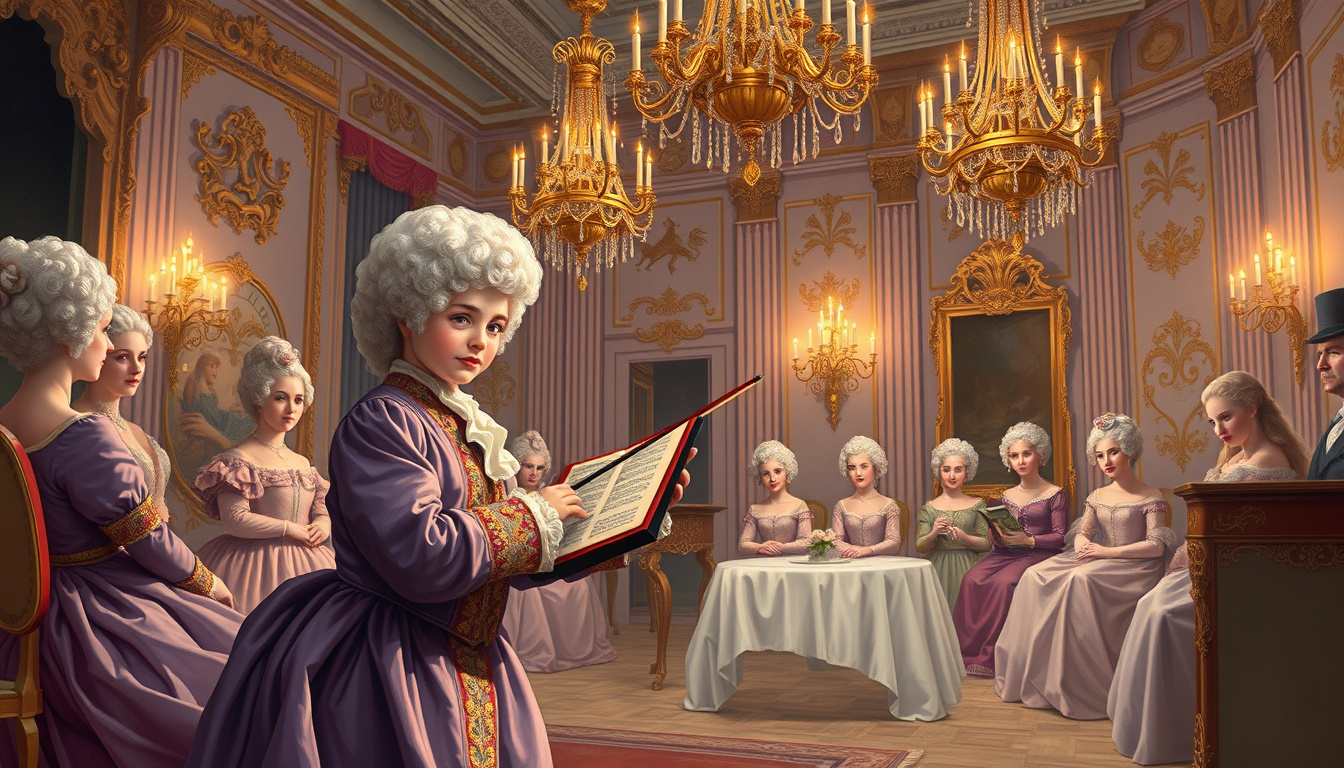
The Grand Tour
In 1763 the Mozart family set out on a tour that would last three and a half years, hauling two child performers through the courts of Munich, Mannheim, Paris, London, The Hague, Amsterdam, and Utrecht, then back through Paris, Zürich, and Donaueschingen to Salzburg. Wolfgang and Nannerl performed party tricks calibrated to astonish -- playing with a cloth draped over the keyboard, identifying notes by ear, improvising on themes handed to them by skeptical noblemen -- alongside serious repertoire. It worked: they played for royalty across half the continent, and the family collected gifts, praise, and occasional real money in roughly that order of frequency. It also nearly killed them. Long stretches by carriage in poor weather, filthy inn rooms, and repeated childhood illnesses -- Wolfgang nearly died of typhoid fever in The Hague in 1765 -- were the unglamorous cost of the spectacle, largely invisible to the audiences marveling at a six-year-old's hands. By the time the family returned home in 1766, Wolfgang had spent roughly half of his conscious childhood outside Salzburg, in carriages and antechambers, learning a version of Europe that almost no other child of his era would ever see.
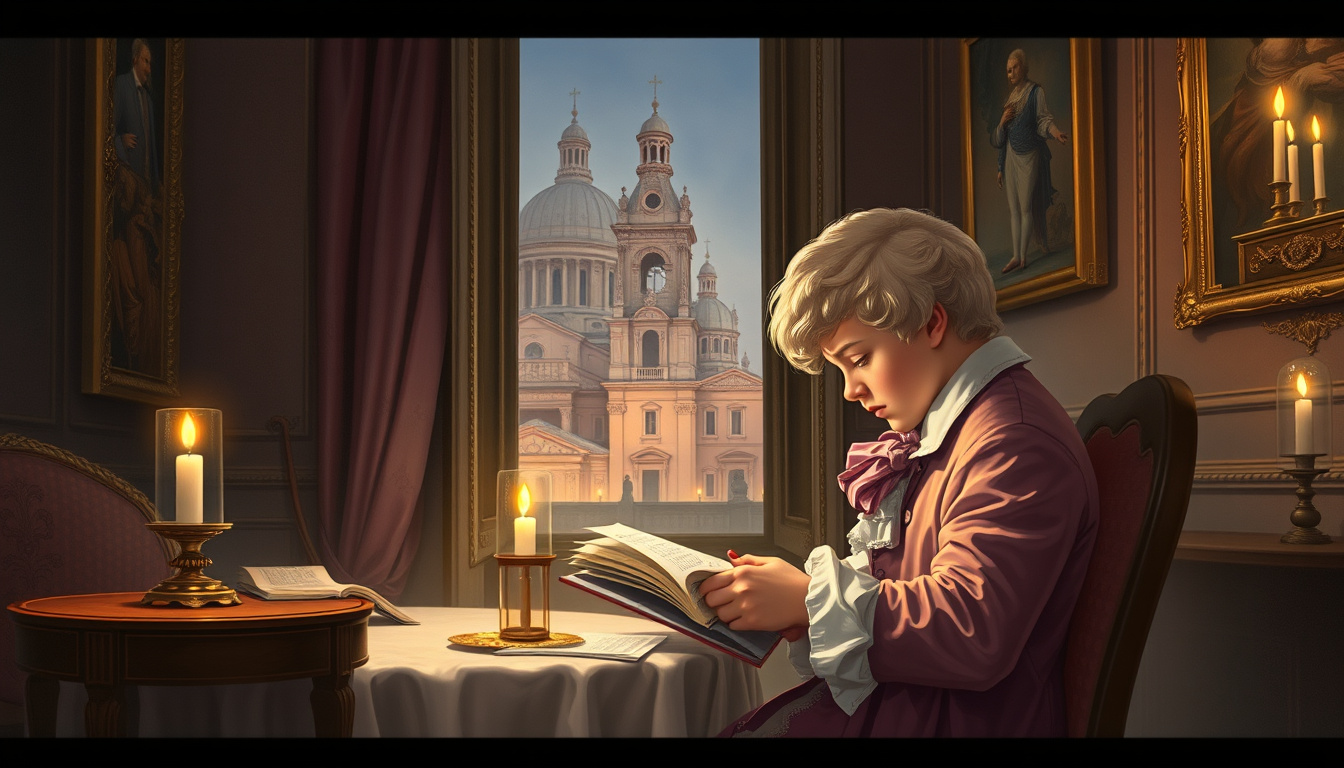
The Forbidden Miserere
In 1769, as Wolfgang turned fourteen and prepared for the first of three trips to Italy with his father, a quieter family decision closed out his sister's public career: Nannerl, now eighteen and of marriageable age, was left behind in Salzburg while the men continued touring. She had been, by Leopold's own written testimony, one of the most accomplished keyboard players in Europe; she would never tour publicly again. In Rome the following year, Wolfgang encountered a piece of music the Catholic Church had spent over a century trying to keep secret: Gregorio Allegri's Miserere, performed only during Holy Week inside the Sistine Chapel, its score forbidden to be copied on pain of excommunication. Wolfgang heard it once, went back to his lodgings, and wrote the entire multi-part piece down from memory. He and Leopold reportedly returned to hear it sung again to check his transcription against the performance. Within a year the score had reached London and was published -- a single teenager's memory had done what a century of Vatican secrecy couldn't prevent.
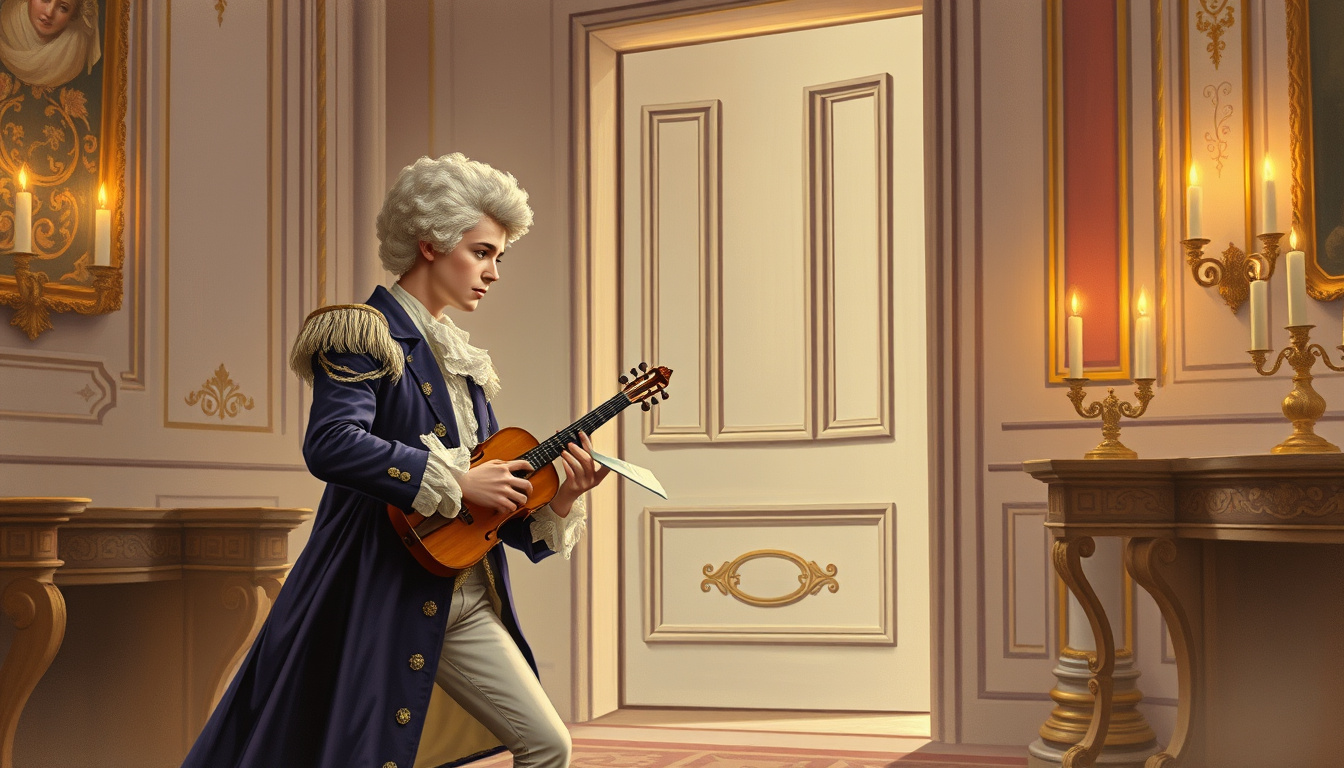
The Archbishop's Boot
From 1773, Wolfgang worked as a court musician for Prince-Archbishop Hieronymus Colloredo of Salzburg, a reforming administrator determined to cut costs and rein in exactly the kind of elaborate musical spectacle the Mozarts specialized in. The relationship soured for years -- in 1777 Wolfgang petitioned for an unpaid discharge just to go job-hunting elsewhere, which Colloredo grudgingly allowed. The real break came in 1781, when Colloredo summoned him to Vienna for the accession celebrations of Emperor Joseph II and treated him, pointedly, as household staff -- ordering him to dine with the valets and cooks, and forbidding him from performing before the Emperor for a private fee equal to half his annual Salzburg salary. Wolfgang tried to resign in May; Colloredo refused to accept it. When permission finally came in June, it arrived as an insult rather than a release: the Archbishop's steward, Count Arco, physically kicked him out of the building. Wolfgang, twenty-five, was free -- unemployed, furious, and newly determined to make it as a freelancer in Vienna rather than ever again wear another nobleman's livery.

Vienna and Constanze
Wolfgang arrived in Vienna in March 1781 and, freed from Salzburg, took lodging with the Weber family -- relatives of a singer he'd been close to years earlier -- where he began courting their nineteen-year-old daughter, Constanze. His mother pressed him to move out for propriety's sake once the courtship became obvious; he did, but the relationship continued, against some resistance from Leopold, who distrusted the Webers' finances and motives. Wolfgang and Constanze married on August 4, 1782, in a side chapel of St. Stephen's Cathedral -- a modest wedding for a composer who was, by then, becoming one of Vienna's most talked-about musicians. His letters throughout their nine-year marriage read as genuinely, consistently devoted; his first major Vienna opera, Die Entführung aus dem Serail (The Abduction from the Seraglio), staged the same year, carries more than a little of the romantic urgency of a man in the middle of exactly this kind of fight for the woman he wanted.
Figaro and the Lodge
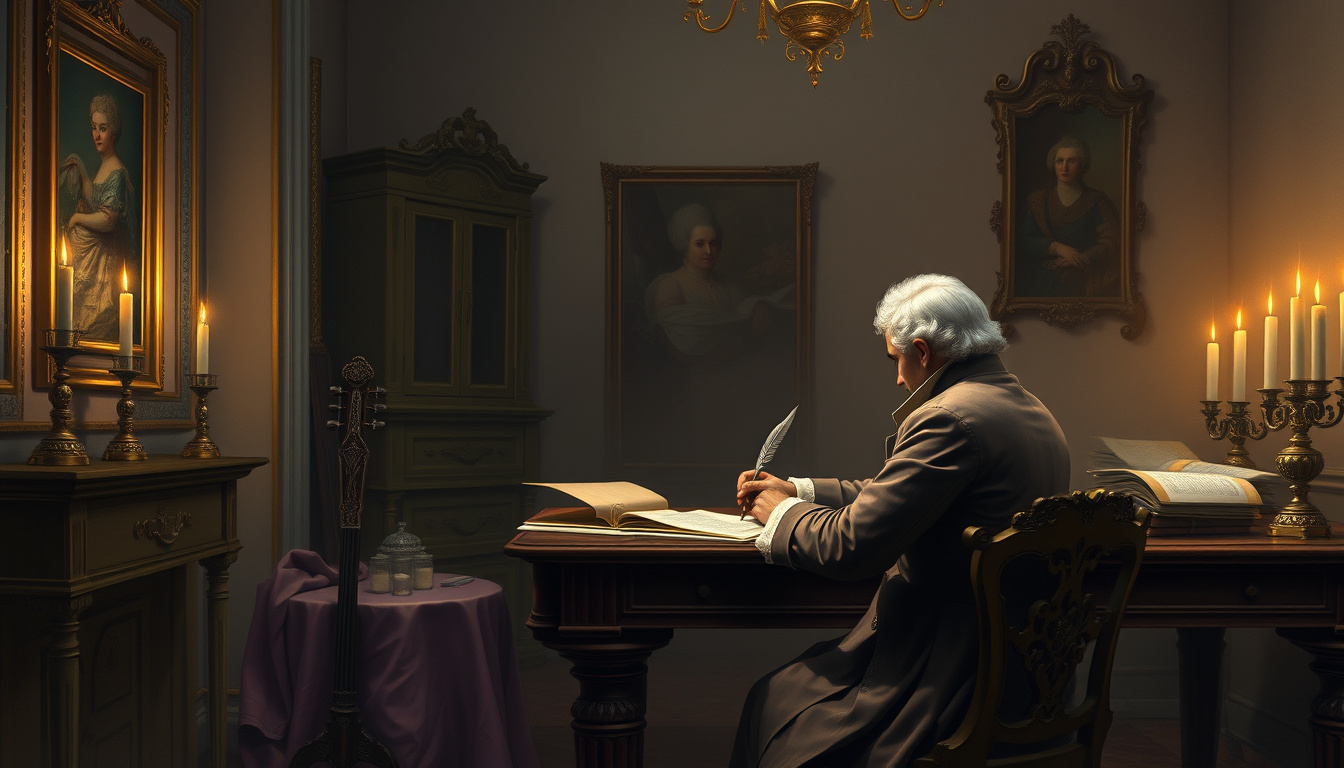
Vienna's freelance economy suited Wolfgang: teaching aristocratic pupils, publishing, concertizing, and taking commissions gave him more income and more creative latitude than Salzburg ever had. In December 1784 he joined a Viennese Masonic lodge, 'Zur Wohltätigkeit' (Beneficence), advancing quickly to Master Mason and later bringing in both his father and his friend Joseph Haydn, an older, hugely respected composer who became one of Wolfgang's closest artistic relationships -- the two men openly admired each other's work in an era when professional rivalry was the norm. In 1786 Wolfgang premiered The Marriage of Figaro, the first of three operas written with the librettist Lorenzo Da Ponte, adapting a French play that had itself been banned in parts of Europe for its satire of aristocratic privilege -- risky material handled deftly enough to become an instant success and, eventually, one of opera's most enduring works. Freemasonry's emphasis on universal brotherhood and hidden symbolic structure would surface again, more explicitly, in a project still five years off: The Magic Flute.

The Statue Comes to Life
Don Giovanni, Wolfgang and Da Ponte's second collaboration, premiered in Prague in October 1787 to a city that had already embraced Figaro more warmly than Vienna had. The opera's climax -- a stone statue of a murdered man coming to life to drag its unrepentant killer down to hell -- became one of the most striking theatrical images of the entire operatic repertoire. These were, by any external measure, Wolfgang's most successful years: steady commissions, a genuine friendship with Haydn, and by some modern archival estimates an annual income of roughly 10,000 florins, comfortably placing him in the top five percent of Vienna's earners. And yet the letters from this period are full of requests to borrow money -- including, more than once, from Haydn himself -- to cover an extravagant household that had moved at least eleven times and a lifestyle that consistently outran even a genuinely large income. The gap between what Wolfgang earned and what people would later believe he earned became, after his death, one of the most durable myths attached to his name.
The Gray Messenger
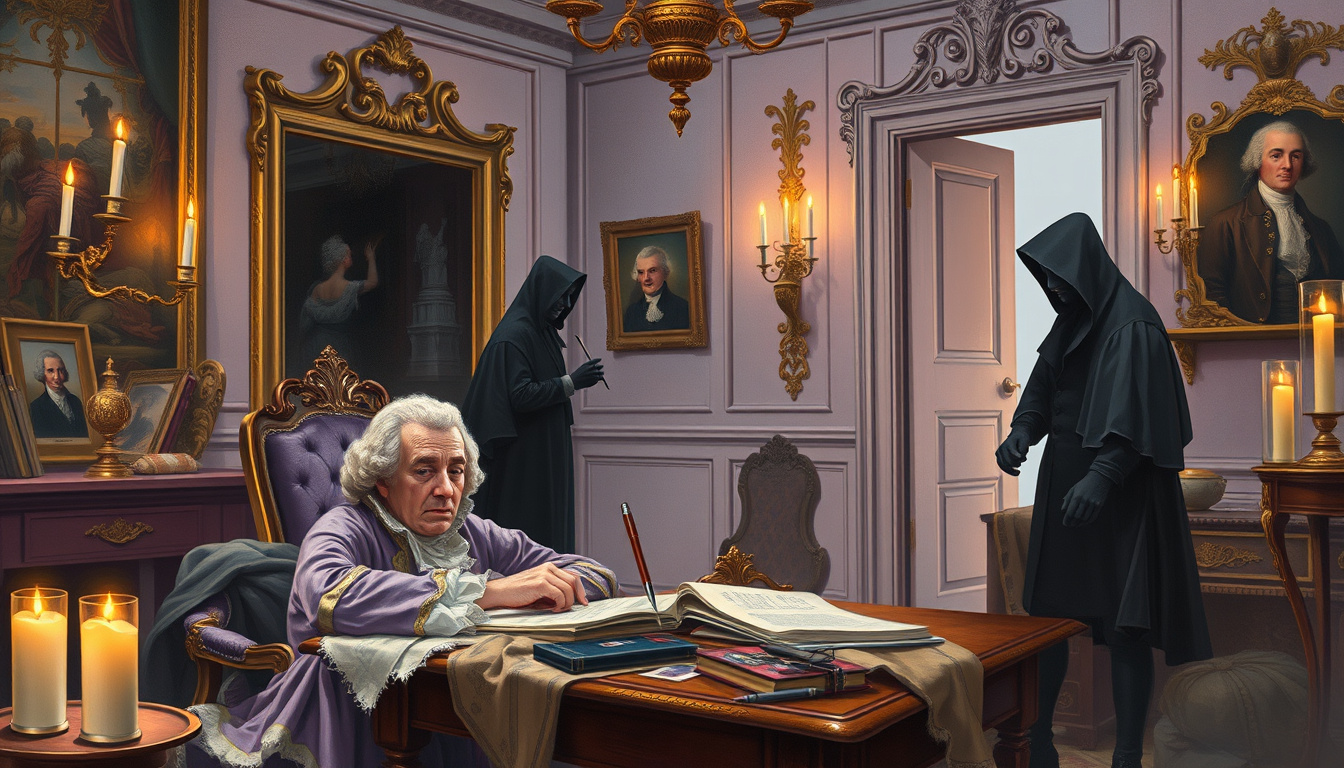
1791 opened with The Magic Flute, an opera saturated with Masonic symbolism -- threes recurring throughout its structure, from three ladies and three spirits to a key signature built on three flats -- and closed with Wolfgang's health collapsing under circumstances that would spawn more conspiracy theories than perhaps any death in music history. Sometime that summer, an anonymous intermediary -- likely a clerk working for a nobleman named Count Franz von Walsegg, who had a habit of commissioning works and passing them off as his own -- approached Wolfgang with a commission for a Requiem Mass. Wolfgang, increasingly ill and reportedly convinced at one low point that the piece was somehow meant for his own funeral, worked on it between other commitments through the autumn. He told Constanze directly that he believed he had been poisoned, a claim he later retracted as his condition briefly improved in November. It did not last. He died on December 5, 1791, at thirty-five, the Requiem still unfinished on his desk.
The Modest Funeral
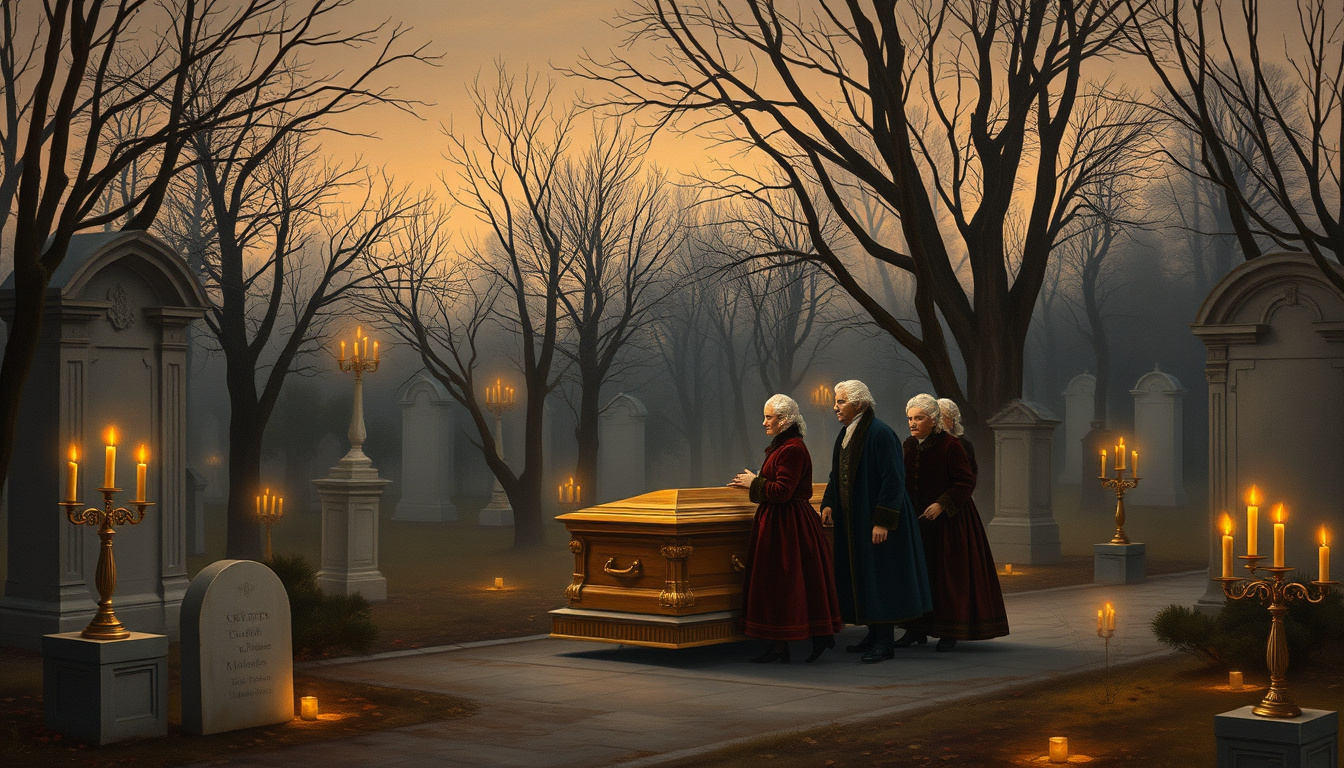
Wolfgang's friend and patron Baron Gottfried van Swieten arranged a standard third-class Viennese funeral -- the choice of roughly 85 percent of the city at the time, costing about eight to twelve florins -- and he was buried in an unmarked but individual grave at St. Marx Cemetery outside the city walls. It was ordinary, not indigent; but ordinary was enough, decades later, to harden into the myth of the genius who died a penniless pauper, an image the 1984 film Amadeus made permanent in the popular imagination alongside its other durable invention: that his rival Antonio Salieri had poisoned him. Salieri, an established contemporary six years older, almost certainly did no such thing -- the rumor began circulating within weeks of the death and was fed decades later by confused, unreliable statements Salieri made while institutionalized and mentally declining near the end of his own life. His student Franz Xaver Süssmayr completed the unfinished Requiem, in a version still debated by scholars but still the one most commonly performed today. Constanze, far from the helpless widow of legend, spent decades actively managing and publishing her late husband's catalog, building the reputation that eventually made him famous enough for a 1993 psychology study about college students and spatial reasoning to spawn an entirely separate modern myth -- that simply playing his music to infants could raise their intelligence.