People Worth Knowing · Volume XI

GRACE HOPPER

1906 — 1992 · New York City, New York
She talked a Navy that didn't want her into making her its oldest active officer, and talked computers that only did arithmetic into speaking English.

The Story in Nine Chapters

Grace Hopper spent her childhood taking apart alarm clocks to see how they worked, then spent her career doing the same thing to bureaucracies, computers, and the assumption that machines could only ever speak in numbers. Rejected from the Navy for being too small, she talked her way in anyway and became one of the first three people in the United States to program a working computer. She built the first compiler when colleagues insisted a machine could never write its own code, helped create the programming language that still runs banks and governments today, and popularized -- without inventing -- the term 'debugging' after a moth turned up in a relay. Forced into retirement twice by Navy age limits, she was recalled twice, and left the service in 1986 as its oldest serving officer. The stories that grew up around her afterward -- the moth, the 'ask forgiveness' line, her rivalry with Ada Lovelace for the title of 'first programmer' -- are almost all slightly more complicated, and more interesting, than the legend.

Seven Alarm Clocks
Chapter 1 · New York, 1906-1928

Seven Alarm Clocks

0:00

Grace Brewster Murray was born December 9, 1906, in New York City, to an insurance broker father and a mother who loved mathematics and made sure her daughter got the same quality of education as her brother -- a deliberate choice in an era that rarely made it. At seven, Grace decided she needed to understand how an alarm clock worked and took one apart to find out. When that didn't fully satisfy her, she took apart six more before her mother realized what was happening to the house's clocks. She was rejected for early admission to Vassar College at sixteen -- her Latin scores weren't high enough -- and admitted the following year instead. She graduated Phi Beta Kappa in 1928 with a degree in mathematics and physics, already showing the trait that would define her entire career: an instinct to open up whatever system was in front of her, whether it was a clock or an institution, and find out exactly how it actually worked rather than accepting how it was supposed to work.

How it workedDismantling seven clocks wasn't destructiveness for its own sake -- each one was a fresh attempt to actually understand the mechanism, the same iterative approach she'd later apply to debugging code and dismantling institutional excuses.
The Quiet Ending
Chapter 2 · 1928-1943

The Quiet Ending

0:00

Grace earned a master's degree from Yale in 1930 and married Vincent Foster Hopper, a Princeton graduate teaching English at NYU, that same June. In 1934 she completed a PhD in mathematics at Yale under Øystein Ore -- an unusual achievement for a woman in that era in any field, let alone mathematics -- while teaching at Vassar, where she was promoted to associate professor by 1941. The marriage quietly fell apart in the early 1940s; the couple separated and eventually divorced in 1945. It was childless, and she never remarried -- but she kept the Hopper surname for the rest of her life and career, the name under which virtually everything she would go on to accomplish became known. By the time the United States entered World War II, she was a tenured, respected professor at a good college, with a doctorate few women of her generation held. She was also, by her own account, restless -- and the war was about to hand her a use for that restlessness that Vassar's classrooms never could.

How it workedA Yale mathematics PhD in 1934 required clearing hurdles far beyond the math itself -- vanishingly few American graduate programs in any quantitative field admitted women at all, let alone to their doctoral ranks.
WAVES and the Mark I
Chapter 3 · 1943-1944

WAVES and the Mark I

0:00

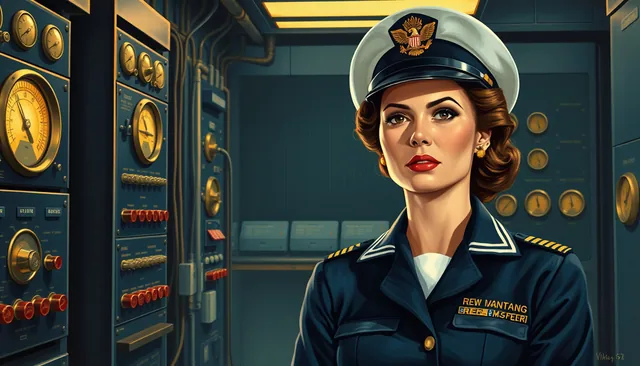
Grace tried to enlist in the Navy in 1943 and was turned down twice over -- she was considered too small and underweight for the physical standards, and her mathematical expertise was judged more valuable kept in a civilian classroom than sent to war. She got a waiver anyway and joined the U.S. Naval Reserve's Women's Reserve, known as the WAVES. She graduated first in her class in 1944 and was commissioned a lieutenant, junior grade, assigned to the Bureau of Ships Computation Project -- housed, unexpectedly, at Harvard University, where a physicist named Howard Aiken had built the Harvard Mark I, the first large-scale electromechanical computer in the United States. Aiken, by most accounts, had not been eager to have a woman placed on his team. He made her his primary programmer within months anyway. Grace became one of the first three people in the country to program a working general-purpose computer -- a role that essentially did not exist as a job title before people like her invented what it meant.
How it workedThe Navy's 'too valuable in a classroom' rejection was, unintentionally, almost exactly backwards: the mathematical teaching career the Navy wanted to keep her in was the direct preparation for the programming work it nearly refused to let her do instead.
The Moth in the Relay
Chapter 4 · 1944-1949

The Moth in the Relay

0:00

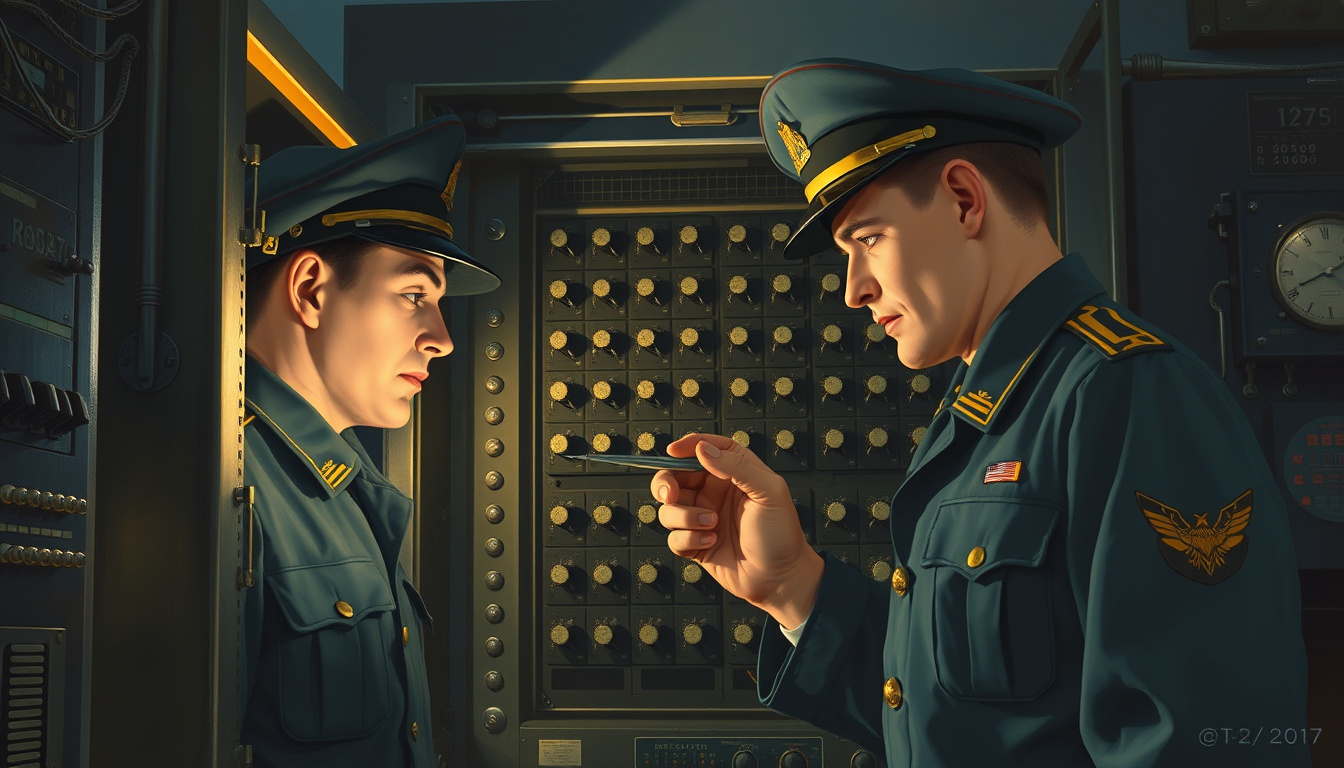
Grace and the Mark I team spent the war on classified calculations that mattered immediately -- rocket trajectories, anti-aircraft gun range tables, minesweeper calibration -- and she personally wrote the 561-page operator's manual for the machine, the first serious documentation of what programming a computer actually involved. On September 9, 1947, working on the Mark I's successor, the Mark II, engineers on the team found an actual moth jammed inside one of the machine's relays, causing a malfunction. Someone -- probably not Grace herself -- taped the moth into the project logbook with the note 'first actual case of bug being found.' The word 'bug' for a technical malfunction already existed; Thomas Edison had used it in an 1878 letter, six decades earlier. What Grace actually did was tell the moth story, for decades afterward, in lecture after lecture, until it became inseparable from her name -- a case of someone becoming a myth's most famous narrator rather than its author.

How it workedThe logbook page survived and is preserved today at the Smithsonian -- physical evidence that lets historians separate what actually happened (a real moth, a real malfunction) from what got attached to it later (the idea that this incident coined 'bug' and 'debug').
A Machine That Writes Its Own Code
Chapter 5 · 1949-1952

A Machine That Writes Its Own Code

0:00

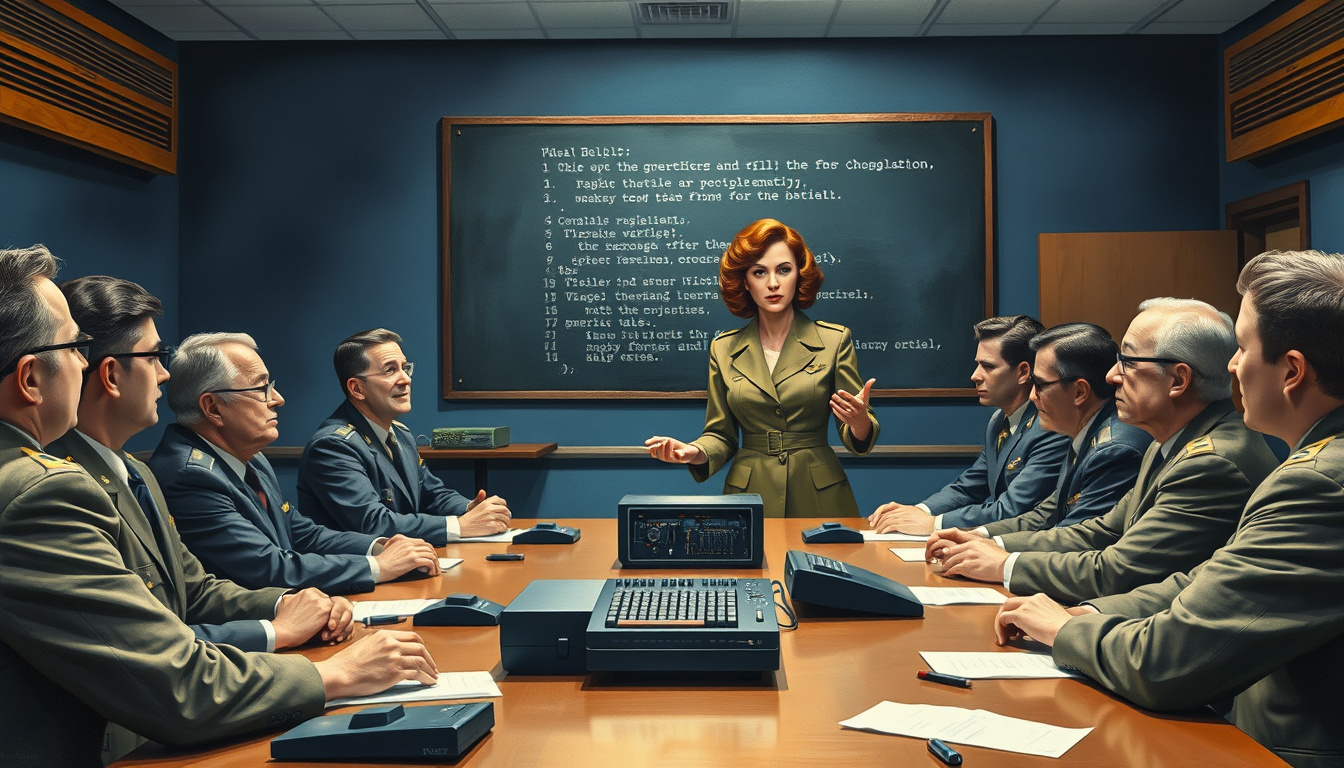
In 1949, Grace left Harvard for the Eckert-Mauchly Computer Corporation, joining the team building UNIVAC, one of the first commercial computers in America, and eventually becoming head programmer on the project. Her real breakthrough came in 1952: a program she called A-0, which she later named a compiler -- software that could translate symbolic instructions written by a human into the binary machine code a computer actually executed. The idea met real resistance. Colleagues, including some with far more formal credentials than hers in the young field, insisted that computers could only do arithmetic and that the notion of a machine translating and effectively writing its own programs was close to nonsensical. Grace kept building it anyway, and kept demonstrating that it worked, until the argument became moot. The compiler is now recognized as one of the foundational ideas of modern computing -- essentially every programming language written since relies on some descendant of the concept she had to argue people into taking seriously in 1952.
How it workedSkepticism about the compiler wasn't irrational for its time -- early computers genuinely were built and marketed as calculators, and the leap to 'a computer can translate and generate its own instructions' was a real conceptual jump, not an obvious next step.
Teaching Computers English
Chapter 6 · 1952-1959

Teaching Computers English

0:00

Grace's next project pushed the compiler idea further: if a machine could translate symbolic math notation into machine code, why not plain English words? In 1956 her team built FLOW-MATIC, the first programming language built around English-like commands rather than mathematical symbols -- a design choice driven partly by her belief that business managers, not just mathematicians, needed to be able to read and eventually write programs themselves. In 1959 she joined the CODASYL consortium, a multi-organization committee working to build a standardized, machine-independent business programming language. The result was COBOL (COmmon Business-Oriented Language). Many people contributed to its formal specification, and Grace did not single-handedly write it -- but she is rightly remembered as the philosophy's driving advocate and the person who built and promoted the compiler technology that made an English-readable language practical to actually run. COBOL went on to become, for decades, the invisible backbone of banking, government, and insurance computing -- code still processing transactions today, more than sixty years after it shipped.
How it workedFLOW-MATIC's English-word commands weren't a simplification for beginners -- they were a deliberate bet that business logic, written by the people who understood the business rather than translated by a specialist mathematician, would produce more reliable programs.
Amazing Grace
Chapter 7 · 1966-1986

Amazing Grace

0:00

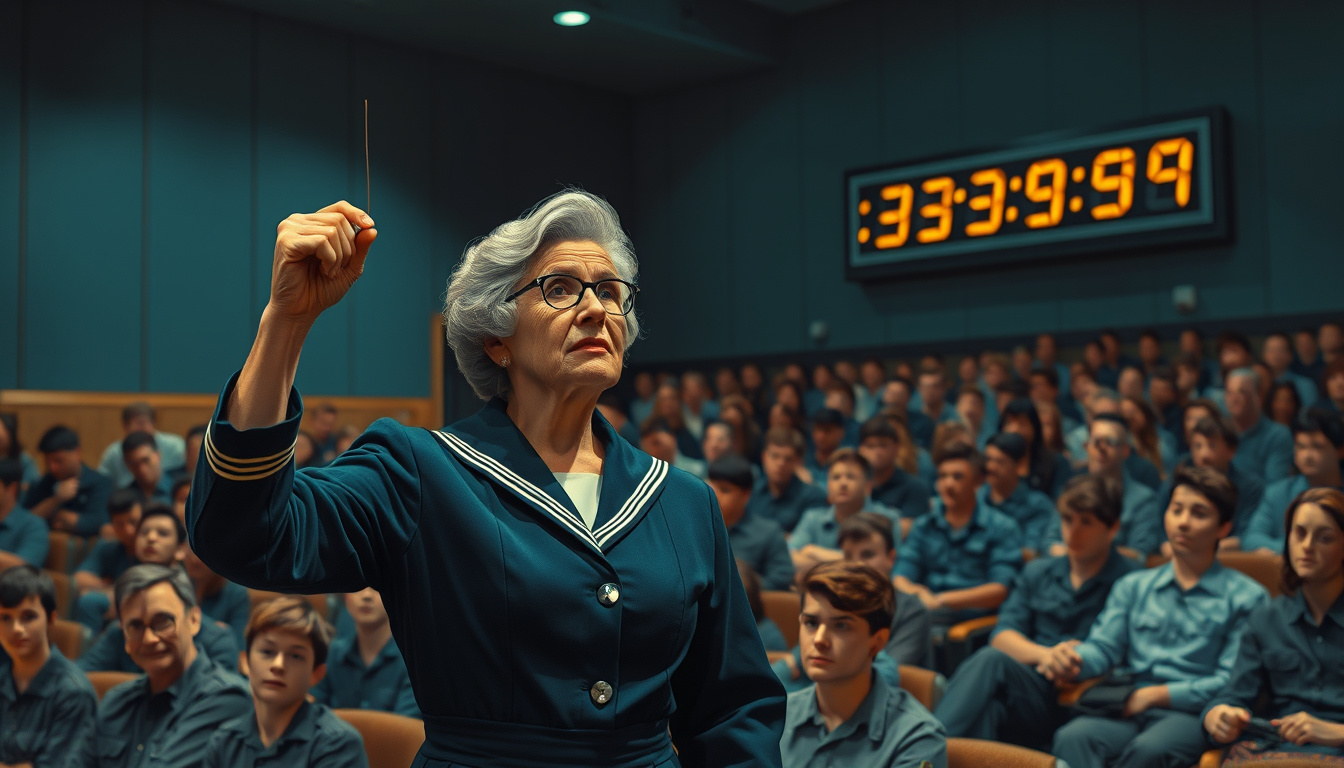
Navy age-limit rules forced Grace into retirement as a commander in 1966. Seven months later, she was recalled to active duty to help the Navy untangle its sprawling, inconsistent mess of incompatible computer languages -- a task suited exactly to the person who had spent the prior decade arguing that programming languages should be standardized and human-readable. Her subordinates nicknamed her 'Amazing Grace.' She became famous on the lecture circuit for a specific piece of showmanship: handing audiences an 11.8-inch length of wire, the maximum distance an electrical signal can travel in one nanosecond, so that engineers arguing about computer speed had something physical to hold instead of an abstract number. In her office she kept a wall clock that ran counterclockwise, explaining that 'humans are allergic to change... that's why I have a clock on my wall that runs counterclockwise' -- a tidy visual argument for the idea, expressed in various forms over many years, that the most dangerous phrase in an organization is some version of 'we've always done it this way.'

How it workedThe nanosecond wire worked as a teaching tool precisely because it converted an unintuitive physical limit -- the speed of electricity, not engineering laziness -- into something skeptical admirals could literally hold in their hands and argue with.
The Oldest Officer
Chapter 8 · 1986-1992

The Oldest Officer

0:00

Grace retired from the Navy for good in 1986, at age seventy-nine, holding the rank of rear admiral and, at the time, the distinction of being the oldest serving officer in the entire U.S. Navy. In 1991 she received the National Medal of Technology, one of the highest honors the United States gives for technical achievement, becoming the first woman to receive it individually. She kept speaking publicly well into her final years, still handing out nanosecond wires, still telling the moth story, still arguing for readable code and against institutional inertia to audiences that by then spanned three generations of engineers who'd grown up on tools built from ideas she'd fought to establish decades earlier. She died at her home in Arlington, Virginia, on New Year's Day, 1992, at eighty-five, and was buried in Arlington National Cemetery with full military honors -- a fitting resting place for someone whose entire adult working life had been spent inside the institution that twice tried to retire her and twice found it couldn't quite do without her.

How it workedAge-based mandatory retirement rules exist to keep military ranks turning over -- Grace Hopper is one of the clearest cases in Navy history of the rule being overridden twice because a single person's specialized expertise had become organizationally irreplaceable.
The Myths That Outlived Her
Chapter 9 · 1992 - today

The Myths That Outlived Her

0:00

In 1994, two years after her death, computer scientist Anita Borg co-founded the Grace Hopper Celebration of Women in Computing in her honor; it began with about five hundred attendees in Washington, D.C., and has since grown into the largest gathering of women and non-binary technologists in the world. In 1996 the Navy launched a guided-missile destroyer, USS Hopper, nicknamed 'Amazing Grace' after her -- one of a short list of American military vessels named for a woman. In 2016, President Obama posthumously awarded her the Presidential Medal of Freedom, the nation's highest civilian honor. Along the way, her legend picked up some rough edges that don't quite match the record: she is often credited with personally coining the words 'bug' and 'debug' rather than simply popularizing an incident and a term both older than she was, and she is sometimes framed as a rival or successor to Ada Lovelace's title of 'first programmer' -- a comparison that misses that Lovelace, a century earlier, never had a working machine to run her ideas on, while Hopper's claim rests on something more concrete: she was one of the first people anywhere to actually sit down and program a real, functioning computer, then spend the following four decades making that work possible for everyone who came after her.

How it workedThe Lovelace/Hopper comparison persists because both are genuinely important to computing history for different reasons -- conceptual foundation versus hands-on engineering lineage -- and popular culture tends to prefer a single clean 'first' rather than two women occupying different, non-competing roles a century apart.

Timeline · 1906 → today

Gold marks the hinge moments.

Dec 9, 1906
Born Grace Brewster Murray in New York City
1913
Dismantles seven alarm clocks at age 7 to see how they work
1928
Graduates Phi Beta Kappa from Vassar College, math and physics
1930
Earns a master's degree at Yale; marries Vincent Foster Hopper
1934
Earns a PhD in mathematics from Yale under Oystein Ore
1941
Promoted to associate professor of mathematics at Vassar
1943
Rejected then accepted (via waiver) into the US Naval Reserve WAVES
1944
Graduates first in her class; commissioned lieutenant, junior grade
1944
Assigned to the Harvard Mark I project under Howard Aiken -- becomes one of the first 3 US computer programmers
1944-45
Writes the 561-page Harvard Mark I operator's manual
1945
Divorces Vincent Hopper; keeps his surname for the rest of her life
Sep 9, 1947
A moth is found jammed in a Mark II relay -- the origin of the 'computer bug' anecdote she later popularized
1949
Joins Eckert-Mauchly Computer Corporation, works on UNIVAC I
1952
Builds A-0, the first compiler, over colleagues' skepticism that machines could write their own code
1956
Team develops FLOW-MATIC, first English-word-based programming language
1959
Joins the CODASYL consortium that develops COBOL
1966
Forced into Navy retirement as a commander due to age limits
1967
Recalled to active duty to standardize the Navy's computer languages
c. 1970s
Popularizes the 11.8-inch 'nanosecond' wire demonstration in lectures
1983
Promoted to commodore (later restyled rear admiral, lower half)
1986
Retires from the Navy at 79 as a rear admiral -- the oldest serving officer in the Navy
1991
Receives the National Medal of Technology
Jan 1, 1992
Dies at home in Arlington, Virginia, age 85
1992
Buried in Arlington National Cemetery with full military honors
1994
Anita Borg and Telle Whitney found the Grace Hopper Celebration of Women in Computing in her honor
1996
USS Hopper (DDG-70), nicknamed 'Amazing Grace,' is launched
Nov 22, 2016
Posthumously awarded the Presidential Medal of Freedom by President Obama

Quotes — and which ones are real

Graded from verified contemporary record to internet-era fabrication.

Verified
“The most dangerous phrase in the language is, 'We've always done it this way.'”
— Grace Hopper
Best-documented version, quoted in Computerworld, 1976
Computerworld, 1976 profile
Verified
“The hardest thing in the world is to change the minds of people who keep saying, 'But we've always done it this way.'”
— Grace Hopper
Earlier, softer phrasing of the same idea in a Baltimore Sun profile
Baltimore Sun, 1975
Reported
“Humans are allergic to change. They love to say, 'We've always done it this way.' I try to fight that. That's why I have a clock on my wall that runs counterclockwise.”
— Grace Hopper
Explaining the backwards clock she kept in her office
Recounted in multiple later interviews and profiles
Plausible
“It's easier to ask forgiveness than it is to get permission.”
— Grace Hopper
Her widely repeated axiom about bureaucratic caution
Frequently quoted in interviews and profiles from the 1980s onward; exact first utterance not independently pinned to a single dated source
Reported
“Life was simple before World War II. After that, we had systems.”
— Grace Hopper
Reflecting on the shift from individual calculation to large-scale computing systems
Widely quoted in retrospectives on her career
Plausible
“A ship in port is safe, but that's not what ships are built for.”
— Grace Hopper
On taking risks rather than staying comfortable
Widely quoted; a nautical maxim she was known to invoke, exact originating context uncertain
Reported
“Grace was a good man.”
— Howard Aiken
His characteristically era-typical praise of Hopper's contribution to the Mark I project, recalled years later
Recounted in oral histories of the Harvard Mark I project
Plausible
“If it's a good idea, go ahead and do it. It's much easier to apologize than it is to get permission.”
— Grace Hopper
A longer variant of her 'forgiveness over permission' line
Various interview compilations; exact wording varies across sources
Verified
“First actual case of bug being found.”
— Mark II project logbook entry (probably not written by Hopper herself)
Note taped alongside the actual moth found in a relay, Sept 9, 1947
Harvard Mark II logbook, now held by the Smithsonian/Naval history archives
Reported
“One accurate measurement is worth a thousand expert opinions.”
— Grace Hopper
On her preference for empirical testing over authority or intuition
Widely quoted in engineering and computing retrospectives
Plausible
“I've always been more interested in the future than in the past.”
— Grace Hopper
On her lifelong preference for solving new problems over reminiscing
Widely quoted; specific original interview source not independently confirmed
Plausible
“You manage things; you lead people.”
— Grace Hopper
On leadership style, a frequently cited maxim of hers
Widely quoted in leadership and management literature attributing it to Hopper
Plausible
“Not all Ada Lovelace's admirers know she never had a working machine to run her program on.”
— Modern historians of computing (paraphrase, not a period quote)
Common scholarly caveat added when comparing Lovelace and Hopper's claims to programming 'firsts'
Paraphrase of a recurring point in computing-history scholarship, not attributed to any single named historian or to Hopper herself

Myths vs. the Record

Grace Hopper coined the terms 'bug' and 'debugging'

The story

The words computer programmers still use for a malfunction and for fixing it were invented when Grace Hopper found a moth in a computer relay in 1947.

The record

A real moth was found jammed in a relay of the Harvard Mark II on September 9, 1947, and taped into the project logbook with the note 'first actual case of bug being found' -- but the entry was very likely made by someone else on the team, not Hopper. More importantly, 'bug' as engineering slang for a malfunction predates this incident by decades: Thomas Edison used the word this way in an 1878 letter. What Hopper actually did was tell this specific anecdote, repeatedly and charismatically, in lectures for the rest of her career, which is why it became permanently associated with her name.

Kernel of truth

She was genuinely on the Mark II team when the moth was found, and the logbook page is real and survives in the Smithsonian -- she just didn't coin the underlying vocabulary, only the famous retelling of one incident.

confidence: high

Grace Hopper invented COBOL

The story

COBOL, the programming language that still runs much of the world's banking and government infrastructure, is credited to Grace Hopper as its inventor.

The record

COBOL was developed by the CODASYL consortium, a committee representing multiple companies and government agencies, in 1959. Hopper was an influential advocate and consultant to that process and had already built the compiler technology (via her earlier language FLOW-MATIC) that made an English-readable business language practical -- but she did not personally write the COBOL specification alone, and many other people contributed directly to the language's design.

Kernel of truth

Her fingerprints are all over COBOL's foundational philosophy and technical groundwork; the myth simplifies a committee effort into a single inventor, which undersells the collaborative reality but doesn't invent her role out of nothing.

confidence: high

Ada Lovelace and Grace Hopper were rivals for the title of 'first programmer'

The story

Popular retellings often frame Lovelace and Hopper as competing candidates for the same historical title, a century apart.

The record

Ada Lovelace, working in the 1840s, wrote detailed notes -- including a table for calculating Bernoulli numbers -- describing how Charles Babbage's never-built Analytical Engine could execute a sequence of operations; she never had a working machine to actually run this on. Grace Hopper, in 1944, was one of the first three people to program an actual, physically working, general-purpose computer, the Harvard Mark I. The two women's contributions are a century apart and different in kind -- conceptual foresight without hardware, versus hands-on operation of real hardware -- rather than directly comparable claims to the same 'first.'

Kernel of truth

Both women are legitimately foundational to computing history; the 'rivalry' framing is a modern simplification that flattens two very different kinds of pioneering into a single competition neither woman was actually part of during her own lifetime.

confidence: medium

Grace Hopper's exact 'ask forgiveness, not permission' quote has one clear original source

The story

This widely repeated Hopper axiom is often presented on quote cards with confident, precise attribution as though it were a single documented statement.

The record

Multiple slightly different versions of the sentiment appear across interviews and profiles from the 1970s and 1980s, with no single confirmed first utterance nailed down by researchers. The underlying idea -- prioritizing action over waiting for bureaucratic approval -- is very consistent with her documented career choices and other verified quotes, but the exact wording popularly quoted today is best treated as reported/paraphrased rather than a single verbatim, precisely dated statement.

Kernel of truth

She very likely said some version of this many times over her decades of public speaking -- the sentiment is authentically hers even though the tidy single-source quote-card version oversimplifies a looser, repeated theme.

confidence: medium

She was rejected by the Navy for being too old

The story

A common shorthand version of her Navy story conflates her initial WWII enlistment rejection with her later, unrelated mandatory-retirement age limits.

The record

Her first Navy rejection, in 1943, was for being underweight/too small for physical standards, and because the Navy initially judged her mathematics teaching more valuable kept in a civilian classroom -- not for being too old. The age-based mandatory retirements came decades later, in 1966 (as a commander) and were overridden by recall to active duty; she eventually retired for good in 1986 at 79.

Kernel of truth

Age genuinely did play a real role in ending her Navy career -- just at the very end of it in the 1960s-80s, not at the beginning in 1943, when the objections were about her size and the perceived value of her civilian expertise.

confidence: medium

The Network — allies, rivals, blood

Howard Aiken

project lead, mentor

Physicist who led the Harvard Mark I project and initially resisted having a woman on his officer corps -- then made Hopper his primary programmer and top deputy within months, co-authoring three papers with her.

Vincent Foster Hopper

husband

Princeton-educated NYU English instructor she married in 1930; they separated in the early 1940s and divorced in 1945. She kept his surname for the rest of her life and career.

John Mauchly and J. Presper Eckert

employers

Founders of the Eckert-Mauchly Computer Corporation (builders of UNIVAC), who hired Hopper in 1949, where she built the first compiler.

Richard Bloch and Robert Campbell

fellow pioneer programmers

Alongside Hopper, one of the first three people in the United States to program the Harvard Mark I when it went online in 1944.

CODASYL consortium

collaborators

The multi-organization committee whose 1959 work produced COBOL, building directly on the compiler and English-language-command philosophy Hopper had already established with FLOW-MATIC.

Anita Borg

legacy successor

Computer scientist who, with Telle Whitney, founded the Grace Hopper Celebration of Women in Computing in 1994, two years after Hopper's death.

Ada Lovelace

historical predecessor, often compared

19th-century mathematician whose notes on Babbage's unbuilt Analytical Engine are often set alongside Hopper's real, working-computer programming as rival claims to computing's 'first' pioneering woman.

Character — eight defining traits

Relentlessly curious about mechanisms

Took apart seven alarm clocks as a child to understand them, then spent her career taking apart computers, institutions, and bureaucratic excuses the same way.

Persistent past rejection

Talked her way into the Navy via waiver after being turned down, and kept building the compiler after colleagues insisted the underlying idea was close to nonsensical.

A natural, charismatic teacher

Famous for the nanosecond wire demonstration and other vivid physical teaching aids that made abstract engineering concepts tangible to skeptical audiences.

Institutionally embedded rebel

Spent virtually her entire adult career inside the Navy and large computing firms while consistently pushing those same institutions to change how they worked.

Practical rather than purist

Prioritized programming languages readable by ordinary business people over mathematically elegant but inaccessible notation.

Fond of physical symbols and props

Kept a counterclockwise wall clock, carried nanosecond wire, and told the moth story for decades -- turning abstract ideas into memorable objects and anecdotes.

Comfortable being underestimated, then proving it wrong

Was dismissed early for her size and later for her age, and outlasted both sets of doubters to become the Navy's oldest serving officer.

More influential than famous

Her compiler and COBOL-adjacent work underpins software most people use every day, even though she remains less universally recognized than earlier figures like Ada Lovelace.

ASK THE ARCHIVE

Have a question this chapter didn’t answer? Ask the archive — answered live, checked against the same research as the story above.

Ambient score