On April 15, 1452, in or near the Tuscan hill town of Vinci, a notary named ser Piero da Vinci and a young woman named Caterina di Meo Lippi had a son they could not legitimize. Piero was a rising professional; Caterina was, by the account of historian Martin Kemp, an orphaned fifteen-year-old girl living in a farmhouse a mile outside town. The two never married. The boy was given his father's name anyway, in the fashion of the time: Leonardo di ser Piero da Vinci -- Leonardo, son of ser Piero, of Vinci.
He spent his first five years with his mother, then moved into his father's household -- grandparents, an uncle named Francesco, and eventually a parade of stepmothers, as ser Piero married four times and produced a dozen legitimate children who would later fight Leonardo over his inheritance. Illegitimacy closed doors. Leonardo could not attend a university or join certain guilds requiring legitimate birth and Latin schooling. He received only a basic education in vernacular reading, writing, and mathematics -- and was left, for the rest of his life, essentially self-taught in everything that mattered to him.
It is tempting, in hindsight, to call this a hidden advantage. Unshackled from the Latin curriculum that trained his contemporaries to argue from authority -- Aristotle said it, therefore it is so -- Leonardo built his own method from scratch: watch closely, record precisely, trust the eye over the text. He would spend the rest of his life being underestimated by scholars and overestimated by mythmakers. Both misjudged what an illegitimate notary's son from a hill town was actually doing in his notebooks.
In 1466, at fourteen, Leonardo was apprenticed to Andrea del Verrocchio, one of Florence's leading workshop masters -- painter, sculptor, and goldsmith all at once, running an operation that trained a generation of Renaissance artists. A bottega like Verrocchio's was less a school than a small factory: apprentices ground pigments, cast bronze, prepared panels, and slowly, painting by painting, absorbed the master's technique until their hand became indistinguishable from his.
Leonardo was accepted into the Florence painters' guild, the Compagnia di San Luca, in 1472 -- but stayed in Verrocchio's workshop five more years, an unusually long apprenticeship that suggests either deep loyalty or that Verrocchio simply couldn't afford to lose him. The most famous anecdote from these years -- almost certainly embellished by Vasari decades later -- claims Verrocchio painted an angel in his Baptism of Christ, saw that his apprentice's angel outshone his own figures, and never picked up a paintbrush again. The story is probably not literally true. The underlying fact it's built on is: by his early twenties, Leonardo's technical skill had already outpaced his teacher's.
He left the workshop around 1477 to build an independent career. What he took with him was not just brushwork but a habit of mind: Verrocchio's shop treated painting as a technical craft requiring anatomy, optics, and engineering knowledge, not a purely intuitive gift. Leonardo would spend the rest of his life treating every discipline the same way.
Freed from Verrocchio's workshop, Leonardo began accepting his own commissions in Florence -- and immediately established the pattern that would define his entire career. He took on ambitious projects, worked on them with extraordinary care, and left an alarming number of them unfinished. The Adoration of the Magi, commissioned in 1481, was abandoned mid-composition when a more interesting opportunity arrived. It would not be the last time.
His mind simply would not stay in one lane. Notebooks from this period jump, sometimes on the same page, from a study of drapery folds to a diagram of gear ratios to a sketch of a fortification wall. He was, by his own later admission and by the testimony of everyone who knew him, constitutionally incapable of considering a project finished -- there was always a better solution one more study away, and the next commission's due date was somebody else's problem.
By the early 1480s, Florence's opportunities for an outsider without powerful family patronage were running thin, and Leonardo's attention had turned north, to a duchy whose ruler needed exactly the kind of restless, multi-disciplinary mind that Florence had struggled to fully employ.
Around 1482, Leonardo entered the service of Ludovico "il Moro" Sforza, Duke of Milan, reportedly presenting himself less as a painter than as a military engineer -- someone who could design bridges, cannons, and siege equipment. It worked. He would remain in Milan for seventeen years, the longest and most productive settled stretch of his life.
The Sforza court gave Leonardo something Florence hadn't: sustained patronage broad enough to support his sprawling curiosity. He designed pageants and stage machinery, drew up plans for an enormous bronze equestrian statue honoring Francesco Sforza (a project he worked on, with interruptions, for roughly twelve years and never cast), studied hydraulics for the city's canal system, and filled notebook after notebook with anatomical, mechanical, and mathematical studies that had nothing to do with any commission at all.
It was in Milan, around 1495, that he began The Last Supper on the refectory wall of Santa Maria delle Grazie -- and it was in Milan, in 1499, that the whole arrangement collapsed. French forces invaded, Ludovico Sforza fell from power, and Leonardo, after seventeen years of stability, was once again a freelance genius without a patron.
In 1502, Leonardo took a job that sits uneasily against his reputation as a gentle vegetarian who bought caged birds just to set them free: chief military engineer to Cesare Borgia, the ruthless son of Pope Alexander VI, then in the middle of a brutal campaign to conquer the Romagna region of central Italy. Leonardo's task was practical and grim -- survey and reinforce fortifications, design new siege engines, map territory for a warlord's advancing army.
He was not the only famous Florentine in Borgia's orbit that year. Niccolò Machiavelli had been dispatched by the Florentine government as a diplomat, tasked with reading Borgia's intentions toward Florence and, if possible, talking him out of attacking. Machiavelli watched the same calculated blend of charm and violence that Leonardo was quietly mapping for military use -- and historians have long noted that Borgia's example shaped both men's work going forward: Machiavelli's unsentimental treatise on power, The Prince, and Leonardo's unsentimental notebooks on the machinery of war.
The Borgia posting lasted less than a year before Borgia's fortunes turned. Leonardo returned to Florence with a portfolio of military engineering sketches and, one suspects, no illusions left about how power actually operated.
Around 1503, back in Florence, Leonardo began a portrait he would never formally deliver and never fully let go of: a half-length painting of a seated woman, hands folded, a faint and much-argued-over smile on her face. He carried the panel with him for the rest of his life, still refining it in France more than a decade later. The most widely accepted identification, first recorded by Vasari, is Lisa Gherardini, wife of the Florentine silk merchant Francesco del Giocondo -- which gives the painting its Italian name, La Gioconda.
That same period brought Leonardo into direct competition with the only artist of the age whose reputation could rival his own. In 1504, Florence commissioned both Leonardo and the much younger Michelangelo to paint enormous battle murals on opposite walls of the Palazzo Vecchio's Council Hall -- the Battle of Anghiari against the Battle of Cascina. The two men, by all accounts, despised each other: a documented street confrontation has Leonardo baiting Michelangelo over a passage of Dante, and Michelangelo firing back with an insult about Leonardo's unfinished bronze horse, abandoned in Milan and "cast in shame." Neither painter finished his mural. Leonardo's experimental wax-based paint technique for the Anghiari began running before it dried, and the wall was later built over. Two of the era's greatest painters, commissioned to outdo each other, both walked away with nothing to show for it -- which, for Leonardo at least, was becoming a pattern.
He worked on the Mona Lisa on and off for roughly sixteen years. It was still unfinished, by his own exacting standard, when he died.
Leonardo's most intensive anatomical work began around 1506, when he witnessed the peaceful death of a hundred-year-old man at the hospital of Santa Maria Nuova in Florence and, in his own words, "dissected him to see the cause of so sweet a death." It was the beginning of a systematic, largely secret research program that would eventually involve roughly thirty human corpses -- extraordinary access for the period, and legally and socially fraught even when permitted.
The collaboration that pushed this work furthest came during the winter of 1510-1511, when Leonardo worked alongside Marcantonio della Torre, a young anatomy professor at the University of Pavia. Together they may have dissected as many as twenty bodies in a single winter, producing some of the most accurate anatomical drawings Europe had ever seen -- studies of the heart's valves, the layered muscles of the shoulder, a fetus in the womb, drawn with a precision that would not be matched in printed anatomy texts for well over a century. Della Torre died of plague in 1511; two years later, without his collaborator, Leonardo dropped the project.
His notebooks from this era range far beyond anatomy: the flow of water in rivers, the flight of birds, the geology of fossils found on mountaintops, the mechanics of light and shadow. None of it was published in his lifetime. Almost none of it was published for centuries after. He was, in a very real sense, doing science largely for an audience of one.
In September 1513, Leonardo arrived in Rome, where Giovanni de' Medici had just become Pope Leo X and Leonardo was welcomed by the pope's brother, Giuliano de' Medici, his new patron. He took rooms in the Belvedere Courtyard of the Apostolic Palace -- the same complex where Michelangelo and Raphael, both younger and both currently more fashionable, were actively working. Leonardo, given a monthly allowance, spent these years on architecture, hydraulics, optics, and a scheme to build a parabolic mirror to speed up the Medici dye industry's boiling process. He studied botany in the Vatican gardens and drew up plans for draining the malarial Pontine Marshes. The pope, notably, forbade him from dissecting cadavers -- cutting off the anatomical work that had consumed his previous decade.
Giuliano de' Medici died in March 1516, and with his protector gone, Leonardo accepted an offer from a young, ambitious king across the Alps: Francis I of France, who granted him the grand title Premier Painter and Engineer and Architect of the King and a manor house, Clos Lucé, a short walk from the royal château at Amboise.
The arrangement, by every account, suited Leonardo far better than papal Rome had. Francis, not yet twenty-five, treated the aging polymath less as staff than as a living wonder to consult -- reportedly visiting him often simply to talk. Leonardo brought three paintings across the Alps with him, carried rather than shipped: the Mona Lisa, St. John the Baptist, and the Virgin and Child with St. Anne. He was, finally, somewhere he didn't have to finish anything to be valued.
Leonardo died at Clos Lucé on May 2, 1519, at the age of sixty-seven; the cause is generally attributed to a recurrent stroke. Giorgio Vasari, writing his biography decades later, recorded a moving detail: that King Francis I held Leonardo's head in his arms as he died. It is one of the most beloved images in Renaissance art history, reproduced in romantic nineteenth-century paintings -- and very possibly untrue. Royal records place Francis at Saint-Germain-en-Laye that day, awaiting the birth of his second son, though some historians caution the records alone aren't fully conclusive. Whether or not the king was in the room, the story tells you something true about how quickly Leonardo's contemporaries needed him to be more than a man.
What he actually left behind was harder to display than a deathbed scene: roughly seven thousand pages of surviving notebooks -- likely a third or less of what he originally filled -- scattered after his death among heirs, collectors, and eventually museums and private buyers across Europe and America. Bill Gates purchased one of them, the Codex Leicester, at auction in 1994. The notebooks contain studies of flight, water, anatomy, geology, optics, and engineering that anticipated ideas the rest of science would not formally arrive at for two, three, sometimes four hundred years -- not because Leonardo built working machines from them, in most cases he didn't, but because he was asking the right questions with an unprecedented commitment to direct observation over inherited authority.
He finished fewer than twenty paintings in a sixty-seven-year life. He is, by any reasonable measure, one of the most influential humans who ever lived. Both of those sentences are true at once, and neither one explains the other. What made Leonardo Leonardo wasn't output. It was a refusal to let any single discipline -- art, anatomy, engineering, water, flight -- hold the whole of his attention for long. He wanted all of it, and he ran out of centuries before he ran out of questions.
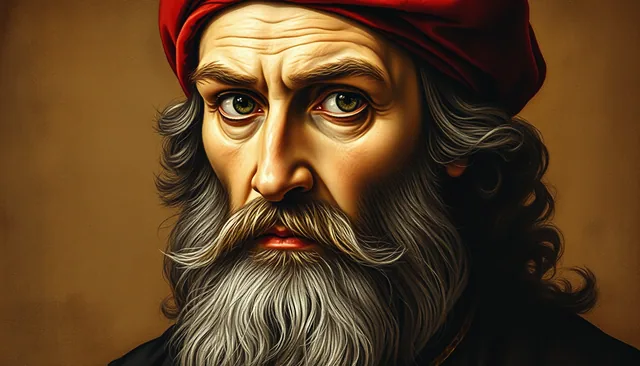
“Just as iron rusts unless it is used, and water putrifies or, in cold, turns to ice, so our intellect spoils unless it is kept in use.”
“He who loves practice without theory is like the sailor who boards ship without a rudder and compass and never knows where he may cast.”
“Obstacles cannot crush me; every obstacle yields to stern resolve. He who is fixed to a star does not change his mind.”
“Why does the eye see a thing more clearly in dreams than the imagination when awake?”
“I have been impressed with the urgency of doing. Knowing is not enough; we must apply. Being willing is not enough; we must do.”
“Painting is poetry which is seen and not heard, and poetry is a painting which is heard but not seen.”
“The noblest pleasure is the joy of understanding.”
“A painter should begin every canvas with a wash of black, because all things in nature are dark except where exposed by the light.”
“Study the science of art; study the art of science.”
“There are three classes of people: those who see, those who see when they are shown, those who do not see.”
“Art is never finished, only abandoned.”
“Water is the driving force of all nature.”
“Simplicity is the ultimate sophistication.”
“For once you have tasted flight, you will forever walk the earth with your eyes turned skyward.”
“Nothing strengthens authority so much as silence.”
“The human foot is a masterpiece of engineering and a work of art.”
Have a question this chapter didn’t answer? Ask the archive — answered live, checked against the same research as the story above.