
The Story in nine chapters

Child of a Crumbling Dynasty
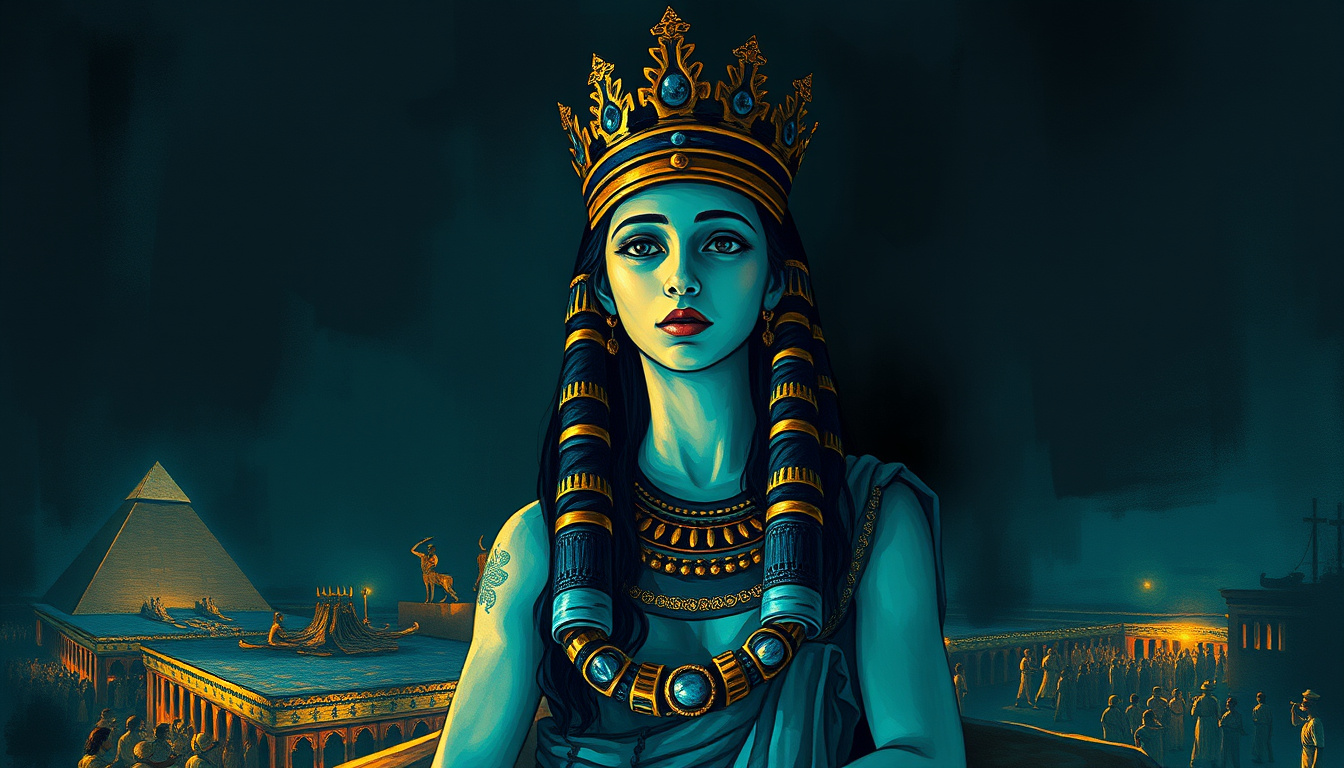
She was born in 69 BC into the strangest royal family in the ancient world. The Ptolemies were not Egyptian at all but Macedonian Greek — the dynasty began when Alexander the Great's general Ptolemy seized Egypt (and Alexander's corpse) after the conqueror's death. For two and a half centuries the family had married brother to sister and settled successions with poison, and by Cleopatra's childhood the kingdom was a Roman client drowning in debt. Her father, Ptolemy XII — nicknamed Auletes, the flute-player — borrowed Rome's money to keep his throne, was chased out by Alexandria's mob in 58 BC, and returned three years later behind Roman spears to execute Cleopatra's older sister Berenice, who had taken the crown in his absence. Cleopatra was fourteen. The lesson could not have been clearer: Rome was the board on which every Egyptian game was played, and family was the first place to look for a knife. Her other inheritance was better. Raised beside the Mouseion and the great Library, she studied rhetoric, philosophy, mathematics and medicine — and became, as far as the record shows, the only Ptolemy in the dynasty's history who bothered to learn the language of Egypt itself.
Queen at Eighteen
Ptolemy XII died in 51 BC, leaving the throne jointly to Cleopatra, eighteen, and her brother-husband Ptolemy XIII, ten. She began ruling as if the boy did not exist — her face on the coins, her name first on the decrees. Reality intruded fast. The Nile flood failed and famine hit Alexandria; she ordered the royal granaries opened. Meanwhile the boy-king's regents, led by the eunuch Pothinus, wanted a pliable child on the throne rather than a queen who gave orders in seven languages. By 49 BC they had the palace, the army and the capital, and Cleopatra was a fugitive. What she did next set the pattern for her whole life: she did not go into exile to disappear. Twenty-one years old, she crossed into Syria and raised a mercenary army, then marched it back to Egypt's border at Pelusium to take her kingdom back by force. The civil war between sister and brother was still deadlocked there when the Roman civil war came ashore and changed everything.
The Sack and the General
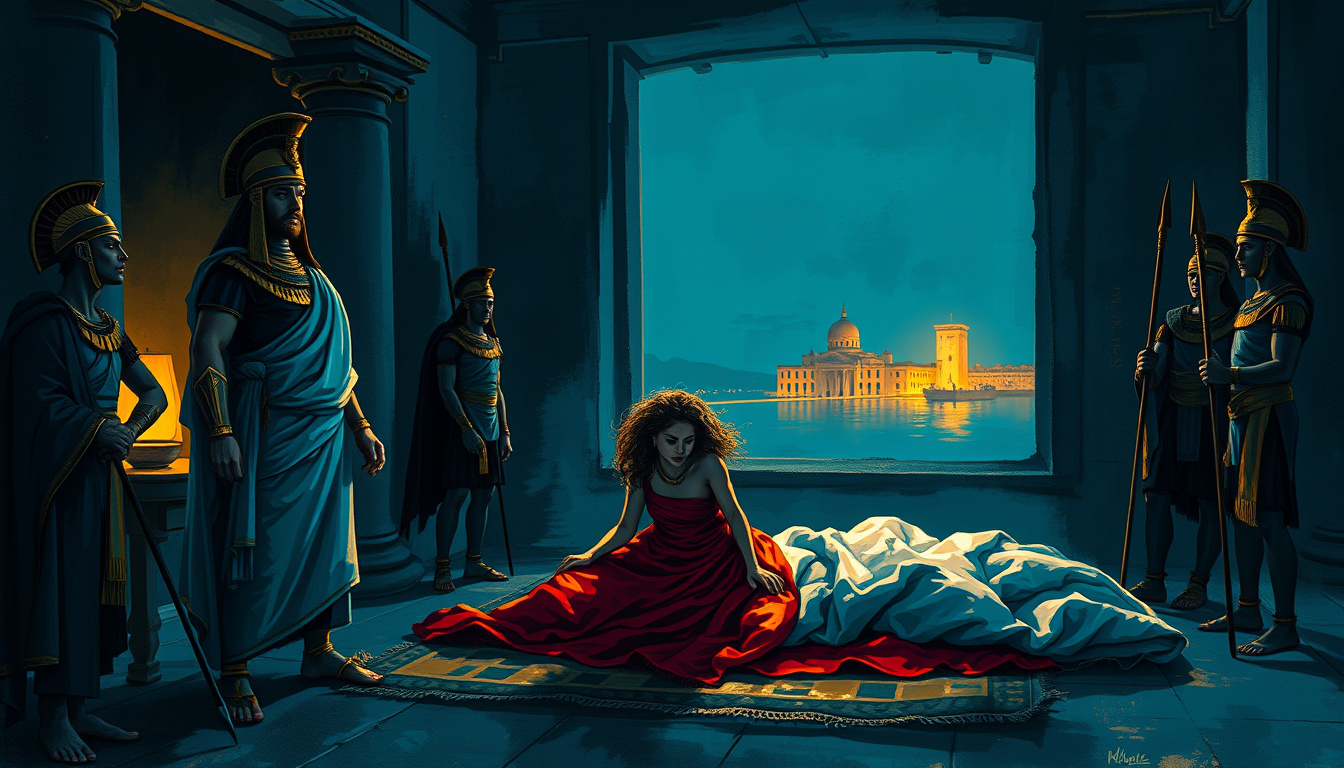
In 48 BC Pompey the Great, freshly beaten by Julius Caesar at Pharsalus, fled to Egypt — and Ptolemy XIII's regents had him beheaded on the beach as a welcome gift to Caesar. Caesar arrived days later, was reportedly disgusted, moved into the palace, and began settling Egypt's debts and its succession. Cleopatra needed an audience the blockade was built to prevent. So she had herself sailed into the harbor at dusk and carried past her brother's guards inside a bedding sack (Plutarch's word; the rolled carpet is a later painter's invention), which was unrolled at Caesar's feet. The nerve of it — a queen gift-wrapping herself as contraband to ambush the most powerful man alive with an alliance proposal — worked. Politically and personally: Caesar backed her claim, and she was soon pregnant. The regents answered with war. The Alexandrian War besieged them in the palace quarter for months — during it Caesar burned the fleet, and the fire spread to warehouses of books, the kernel of the Library-burning legend. Reinforcements finally broke the siege in 47 BC; Ptolemy XIII drowned in the Nile in full armor, and Cleopatra had her throne back, with a new ten-year-old brother, Ptolemy XIV, as ceremonial co-ruler.
Queen of the Nile, Guest of Rome
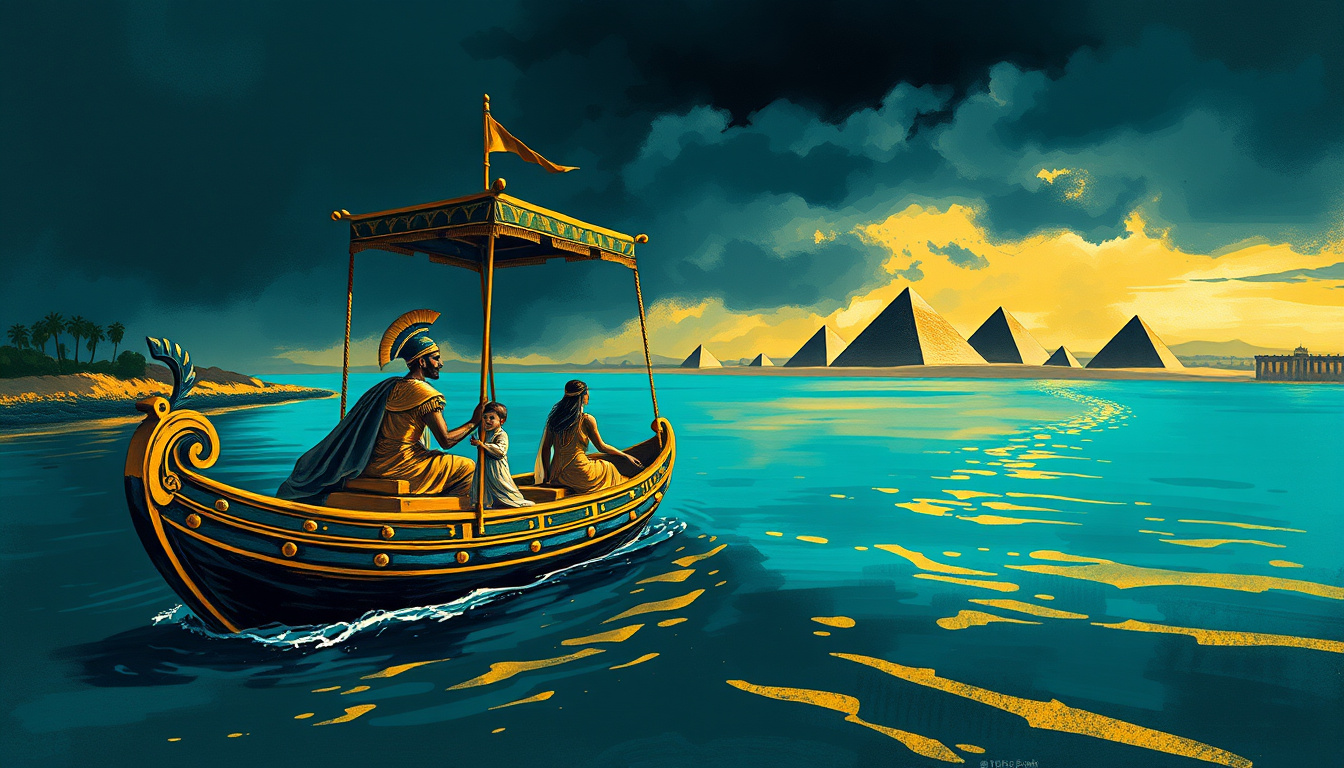
On 23 June 47 BC she gave birth to a son and named him Ptolemy XV Caesar — Alexandria called him Caesarion, little Caesar. Whether or not Caesar formally acknowledged him, he never denied him, and no one looking at the child's parentage missed the point: a son uniting Rome's greatest general with Egypt's throne. She toured the Nile with Caesar in a four-hundred-foot pleasure barge, queen and god-king on display for every temple town. From 46 BC she lived in Caesar's villa across the Tiber — husband parked in an adjoining suite — while Caesar installed a golden statue of her in the temple of Venus Genetrix, ancestress of his own family: an honor without precedent, and Rome hated it. Cicero, who visited and got snubbed over some promised books, spat 'I hate the Queen' into a letter. On the Ides of March 44 BC the knives found Caesar, and Cleopatra's Roman fortress evaporated between one hour and the next. She slipped home to Egypt — where her co-ruler brother conveniently died (poison, the sources assume, and few doubt whose) — and crowned three-year-old Caesarion co-regent. She spent the next three years feeding, arming and dodging both sides of Rome's civil war, waiting to see which Roman would matter next.
The Goddess on the Golden Barge
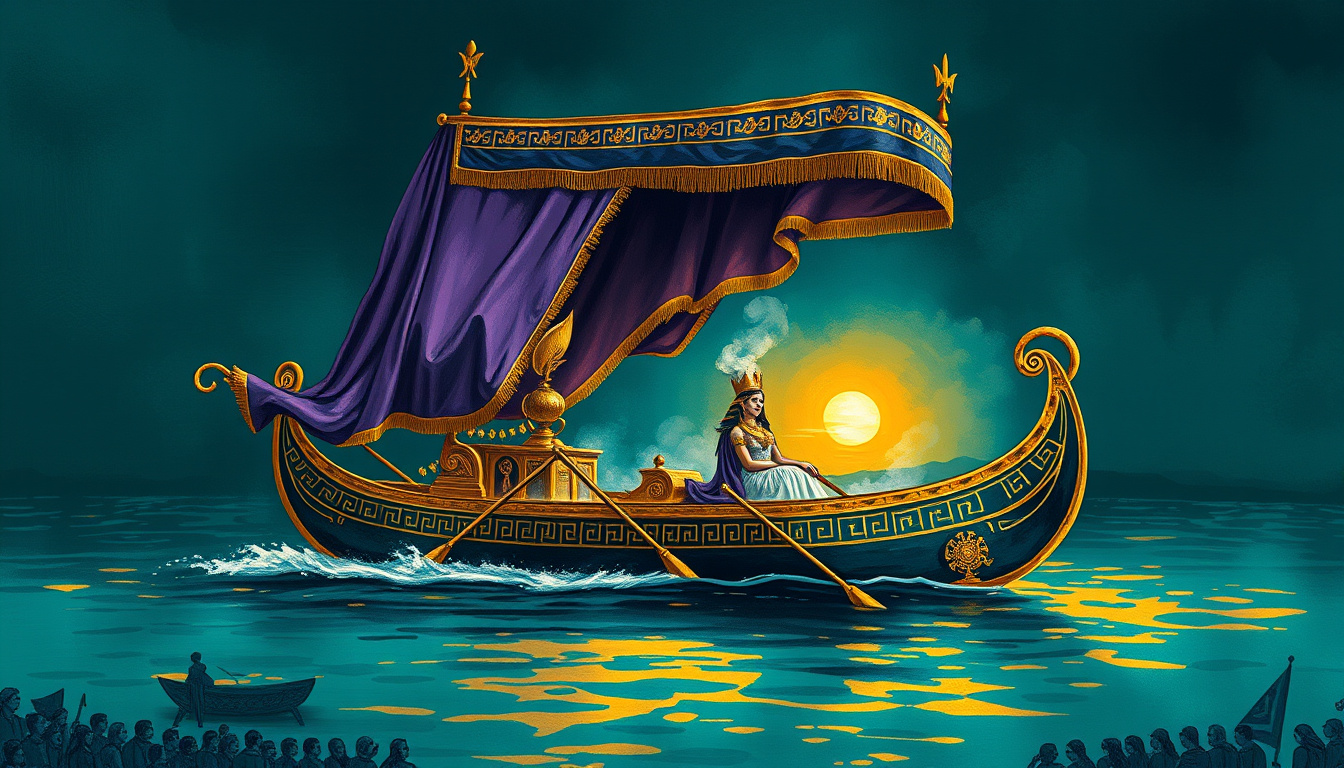
The Roman who mattered next was Mark Antony, master of the East after Philippi. In 41 BC he summoned Cleopatra to Tarsus to answer charges of aiding his enemies. She came — late, magnificently, and on her own terms: a barge with a gilded stern, purple sails and silver oars, flutes playing, herself dressed as Aphrodite beneath a gold-spangled canopy while the city emptied to stare. The summons became her audience. Antony, who styled himself the New Dionysus, got the message — Aphrodite had come to feast with Dionysus for the good of Asia — and followed her to Alexandria for a winter of legendary excess. They founded a drinking society, the Inimitable Livers; she hunted, diced, and (Plutarch swears) roamed the streets with him in servant's clothes banging on doors. It was never only pleasure. Antony needed Egypt's fleet and treasury for his planned Parthian war; Cleopatra needed Rome's strongman and a head. Her price was collected at Ephesus, where her exiled sister Arsinoe — who had once worn her crown — was dragged from the temple of Artemis and killed on Antony's order. In 40 BC Cleopatra bore him twins, Alexander Helios and Cleopatra Selene: sun and moon. Antony, meanwhile, was in Rome marrying Octavian's sister.
Empire of Two
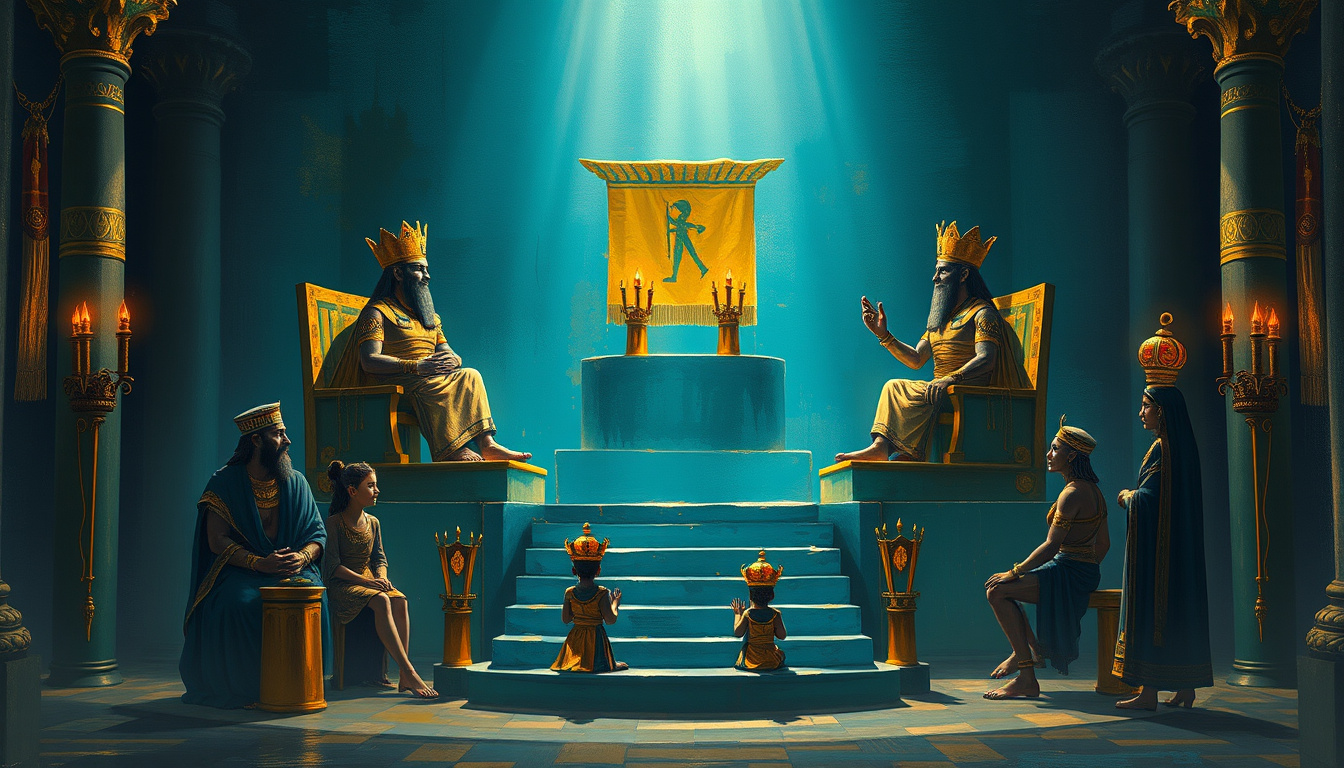
The marriage to Octavia bought four years of separation, not an ending. In 37 BC Antony came east again for his Parthian war, sent for Cleopatra — and this time it was permanent: marriage by Egyptian rite (bigamous in Roman law, meaningless in Egyptian), a third child, Ptolemy Philadelphus, and a bride-price of territories: Cyprus, chunks of Cilicia and Coele-Syria, the balsam groves of Jericho carved out of Herod's kingdom. On paper she had rebuilt the Ptolemaic empire of two centuries earlier. When Antony's Parthian campaign collapsed in the snow with tens of thousands dead, it was her money that refitted his army. The partnership's high noon came in 34 BC. After a face-saving conquest of Armenia, Antony celebrated a triumph through Alexandria — a ritual that belonged to Rome, performed in a foreign capital — and then staged the ceremony history calls the Donations of Alexandria. On a silver stage, on golden thrones, Cleopatra sat robed as Isis while Antony proclaimed her Queen of Kings and distributed Rome's eastern lands among her children. Thirteen-year-old Caesarion was declared Julius Caesar's true son and King of Kings. In one afternoon of theater she had crowned her dynasty over half the Roman world — and handed Octavian the propaganda gift of his life.
The War of Words and Water
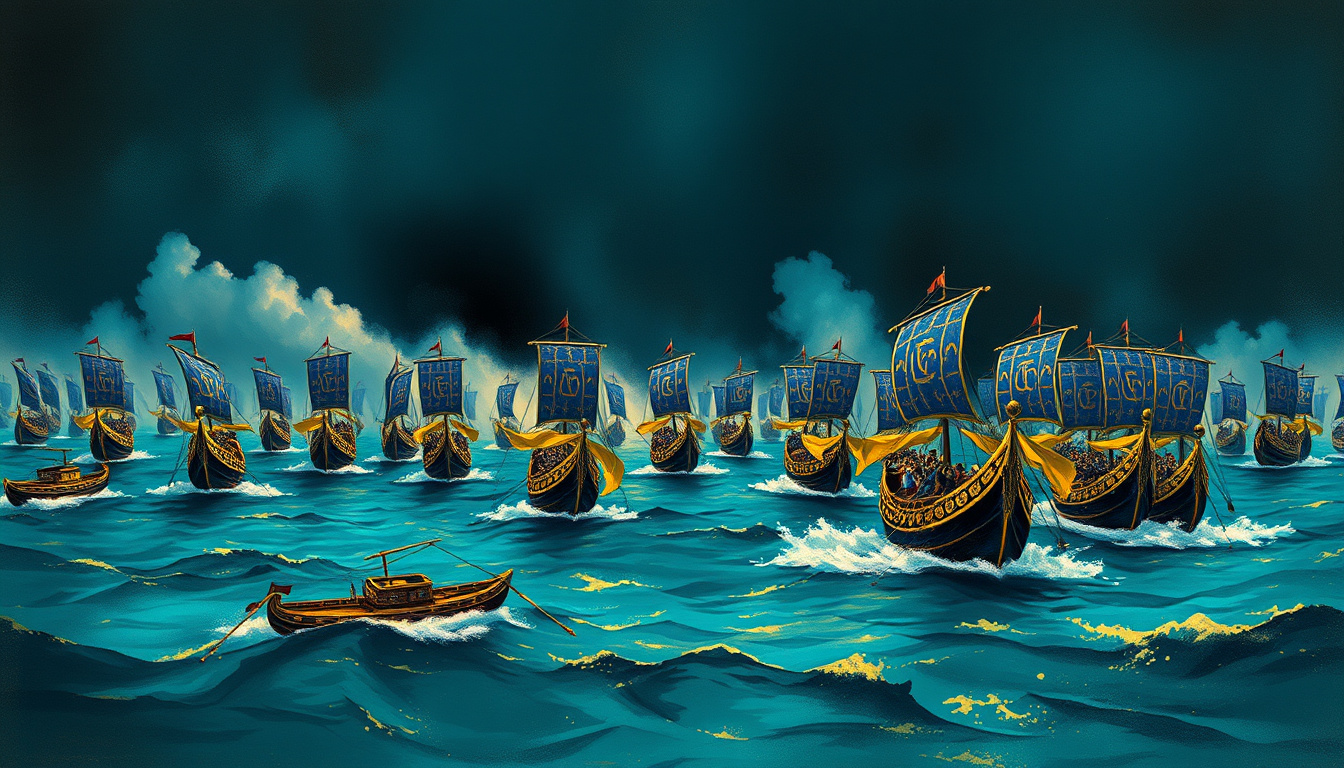
The last war of the Roman Republic began as a media campaign, and Cleopatra was its target. Octavian could not sell a civil war against Antony, a Roman hero — so he sold a foreign war against the witch-queen who had 'enslaved' him: drunk on Egyptian wine, lost to a woman he saluted her at dinner, deranged enough to give Roman land to her children. In 32 BC Octavian committed an outrage that worked: he seized Antony's will from the Vestal Virgins and read it to the Senate — legacies to Cleopatra's children, and instructions to be buried in Alexandria beside her. Rome declared war on Cleopatra alone; Antony was merely deleted. The fleets met on 2 September 31 BC off Actium in western Greece, where Octavian's admiral Agrippa had spent a summer strangling Antony's supply lines while disease hollowed out his crews. What happened next is still argued: mid-battle, Cleopatra's squadron of sixty ships hoisted sail and ran the gap — carrying the war treasury — and Antony abandoned his flagship and fled after her. Betrayal, said Rome. A pre-agreed breakout of whatever could be saved, say most modern historians. Either way the fleet burned, the legions surrendered without him, and the war was over in an afternoon that the two of them spent sailing south in silence.
The Mausoleum
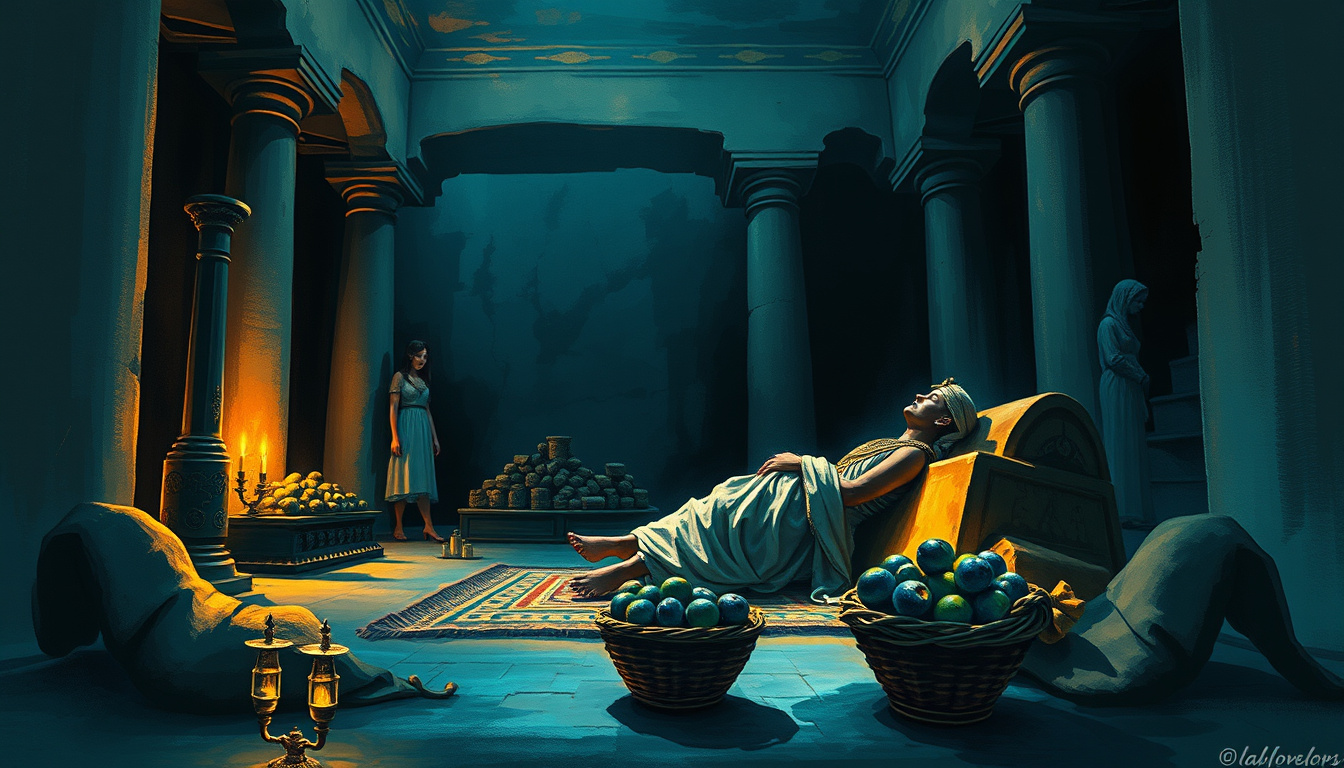
They spent the last year in Alexandria in a new drinking society — renamed, with black Ptolemaic wit, the Companions in Death. Cleopatra tested poisons on condemned prisoners (the sources say) and moved her treasure into her half-finished mausoleum by the temple of Isis: gold, pearls, ebony, cinnamon — and firewood, a standing threat to burn the fortune Octavian's bankrupt regime needed. When Octavian's army reached Alexandria on 1 August 30 BC, Antony's remaining fleet and cavalry defected. Told falsely that Cleopatra was dead, Antony stabbed himself — then, still living, was carried to the mausoleum and hauled up through a window by the queen and her two maids, to die in her arms. Octavian took her alive, and the last negotiation of her life began. He needed her breathing until the treasure was secured; she needed to know one thing, and learned it: he meant to parade her through Rome in his triumph, as her sister had been paraded. On 10 or 12 August, after a bath and a meal, a basket arrived — figs, says the story, with something coiled beneath. Octavian's men found her dead in her royal robes, her maids dying beside her. 'Was this well done of your lady?' a guard demanded. 'It is well done,' said Charmion, 'and fitting for a princess descended of so many royal kings.' Caesarion, seventeen, was hunted down within days — 'too many Caesars,' shrugged Octavian's philosopher. Egypt became a Roman province, and the Hellenistic Age was over.

The Longest Afterlife
Octavian won the war and wrote the woman: the drunken seductress, the fatale monstrum of Horace's victory ode — though even Horace, by the final stanza, is saluting her courage: no humble woman she. Rome's monster proved indestructible precisely because Rome made her fascinating, and every age since has re-cast her in its own anxieties: Shakespeare's infinite variety, the painters' nude with the snake, Elizabeth Taylor under a metric ton of eyeliner, a thousand modern arguments about her face and her race — the last kept genuinely open by one real gap in the record, the identity of her mother. The Arabic tradition, undistracted by Roman propaganda, remembered someone else entirely: al-Masudi's sage and philosopher, author of medical works, patron of scholars. The scholar-queen is the version the evidence actually supports — nine languages, famine relief, currency reform, twenty-one years upright on a throne that had killed most of her family. Two mysteries guard her still. Her tomb — shared with Antony, by her last request and Octavian's grant — has never been found; Kathleen Martínez has hunted it under the temple of Taposiris Magna since 2005, through a 4,300-foot tunnel and a sunken harbor. And one calendar fact keeps her in perspective: the pyramids were more ancient to Cleopatra than Cleopatra is to us — she lived closer in time to the Moon landing than to the building of Giza.