
Ching Shih
She started in a Canton brothel and ended up commanding the largest pirate fleet in history — bigger than most national navies of her day. Then, unlike nearly every pirate before or since, she negotiated her own retirement and died peacefully in old age.
Ching Shih — born Shi Yang around 1775, likely to a marginalized Tanka boat-dwelling family in Guangdong — worked a Canton floating brothel before marrying pirate captain Zheng Yi in 1801 as a full partner, not a subordinate wife. When he died in 1807, she seized command of his Red Flag Fleet and, with her lieutenant (and later second husband) Zhang Bao, built the largest pirate confederation in recorded history: by contemporary Qing estimates, up to 1,800 ships and 50,000–80,000 people, run under a written code punishing disobedience, theft, and assault of captives with death. After defeating Qing and Portuguese naval forces across 1808–1810, she negotiated a mass amnesty on her own terms, kept her fortune, and retired to run a gambling house — dying peacefully in her late sixties in 1844, one of the few major pirate commanders in history to escape the sea, the gallows, or the battlefield.

The Floating World
Ching Shih was born around 1775 in Guangdong province, likely to a Tanka boat-dwelling family — the region's marginalized "water people," barred by custom from living on land or marrying into shore society. Her birth name is recorded variously as Shi Yang or Shi Xianggu, and almost nothing certain survives about her childhood. By her twenties she was working aboard a floating brothel, or "flower boat," in the Cantonese port of Guangzhou — one of thousands of women who serviced merchants, officials, and sailors on the Pearl River's crowded waterways, a trade Tanka women were funneled into by exclusion from almost every other livelihood.
Canton's flower boats were not just brothels but information exchanges — merchants, smugglers, and naval officers gossiped freely aboard them, believing the women posed no threat. That access made a sharp, socially invisible woman like Shi Yang uniquely positioned to learn the trade routes, bribery networks, and rivalries she would later exploit as a pirate commander.

A Marriage of Equals
In 1801, pirate captain Zheng Yi — head of the Red Flag Fleet and heir to a family piracy business stretching back generations — set his sights on the 26-year-old brothel worker known as Shi Yang. Accounts differ on how they met: some say his men raided the flower boat and delivered her to him; others suggest a more deliberate courtship. What multiple sources agree on is the marriage's terms: she would not simply become his wife but his full partner, reportedly securing an equal share of plunder and equal authority over fleet affairs as a condition of the union. She took the name history remembers her by — Zheng Yi Sao, "Zheng Yi's wife" — and immediately began exercising real command alongside her new husband.
Piracy in the Pearl River Delta ran on kinship and patronage, not central command — captains answered to family heads, not titles. By marrying in as a full partner rather than a subordinate wife, Shi Yang inserted herself directly into that kinship hierarchy, giving her a legitimate claim to authority no outsider, male or female, could otherwise have obtained.

Six Flags, One Fleet
Through the early 1800s, Zheng Yi worked to unite the fractious pirate gangs of the South China coast into a single confederation, and by July 1805 the alliance was formalized: six fleets, each flying a different colored flag — red, black, white, blue, yellow, green — with the Zhengs commanding the largest, the Red Flag Fleet. Zheng Yi also adopted a fifteen-year-old fisherman's son, Zhang Bao, abducted by pirates in 1798, grooming him into a skilled lieutenant. Ching Shih, meanwhile, was building the administrative machinery — plunder registries, supply networks, alliances — that let the confederation function as something closer to a floating state than a loose gang, a role that positioned her to inherit real command when her husband was gone.
A pirate confederation this size couldn't survive on raiding alone — it needed food, gunpowder, intelligence, and a way to stop six semi-independent fleets from robbing each other. By building the bookkeeping and provisioning systems that kept the confederation solvent, Ching Shih made herself operationally indispensable years before she ever took formal command.

Taking the Flag
Zheng Yi died in 1807 — accounts differ on the exact circumstances, with most describing a storm at sea off Vietnam — leaving the Red Flag Fleet without an obvious heir. Ching Shih moved fast. With the backing of Zhang Bao, now a battle-tested captain in his twenties, and other senior kinsmen, she claimed command of the fleet herself. A Qing official's report on the confederation later noted flatly that Zhang Bao "obeyed Zheng Yi Sao's orders, and consulted her on all things before acting" — a rare piece of contemporary written testimony confirming her authority wasn't ceremonial. She also began a relationship with Zhang Bao, her late husband's adopted son, that blurred the lines between family, command structure, and romance.
Succession by a widow was almost unheard of in Qing-era piracy, so Ching Shih secured her position the way any warlord would — by binding the fleet's most capable fighter to her personally. Making Zhang Bao her consort fused military loyalty and family obligation into a single relationship no rival captain could easily contest.

Code of the Red Flag
Under Ching Shih and Zhang Bao, the confederation operated by a written code, preserved in the Qing scholar Yuan Yonglun's 1830 account: plunder had to be registered before distribution, with captors keeping only a fifth and the rest going to a general fund; going ashore without permission meant mutilation and execution; disobeying an order meant beheading on the spot. Captured women were to be registered, housed separately, and left unharmed — rape was a capital offense for both parties if consensual sex with a captive was discovered. The code turned a loose alliance of raiders into a disciplined, self-financing organization capable of coordinating tens of thousands of fighters across hundreds of ships without collapsing into infighting.
Historians increasingly credit Zhang Bao, not Ching Shih, with authoring the code, a distinction blurred by a sensationalized 1932 English pirate history that attributed it to her directly. But as supreme commander she held final authority over its enforcement — meaning its brutal logic, protect the profit engine and punish anything that threatens it, still ran through her chain of command.

War on Two Navies

The Negotiated Retirement
Facing a costlier war of attrition despite her battlefield successes, Ching Shih chose to negotiate rather than fight to the end. After early talks collapsed in February 1810 amid mutual suspicion, she personally led a delegation of seventeen women and children into the Viceroy of Liangguang's headquarters in Canton on April 17, 1810, to negotiate face to face. On April 20, roughly 17,000 pirates and over 200 ships formally surrendered at Furongsha. The terms were remarkably favorable: most pirates were pardoned outright, Zhang Bao was commissioned as a Qing military officer, and Ching Shih was permitted to keep her ships and wealth and to formally marry Zhang Bao. A hard core of roughly 140 pirates convicted of the worst crimes were executed or exiled.
By 1810 her fleet was still strong enough to make a fight costly, but had lost enough ground to a two-government alliance that outright victory looked unlikely — real leverage without desperation. Negotiating from that middle ground, rather than total strength or total defeat, let her keep both her money and her freedom, an outcome almost no pirate commander in history achieved.

The Last Decades
After the amnesty, Ching Shih settled into a startlingly ordinary second act. She married Zhang Bao formally in 1813 and bore him a son, Zhang Yulin, while he served as a Qing naval officer; he died in 1822, still in his thirties, while stationed near the Penghu Islands. Ching Shih returned to Guangdong with their son around 1824 and opened a gambling house, by most accounts a lucrative, semi-legal operation. In 1840, in her mid-sixties, she formally sued a Qing official for embezzling 28,000 taels of silver Zhang Bao had once handed over for a family estate; the case was dismissed at the emperor's order. She died in Guangdong's Nanhai district in 1844, in her late sixties.
Most pirate commanders of her era ended up executed, imprisoned, or dead in battle — dying quietly of old age was itself the anomaly. Her 1810 amnesty deal converted illicit wealth into a legally protected fortune and put a loyal military officer at the head of her household, insulating her from exactly the kind of arbitrary official abuse she still had to sue over in 1840.
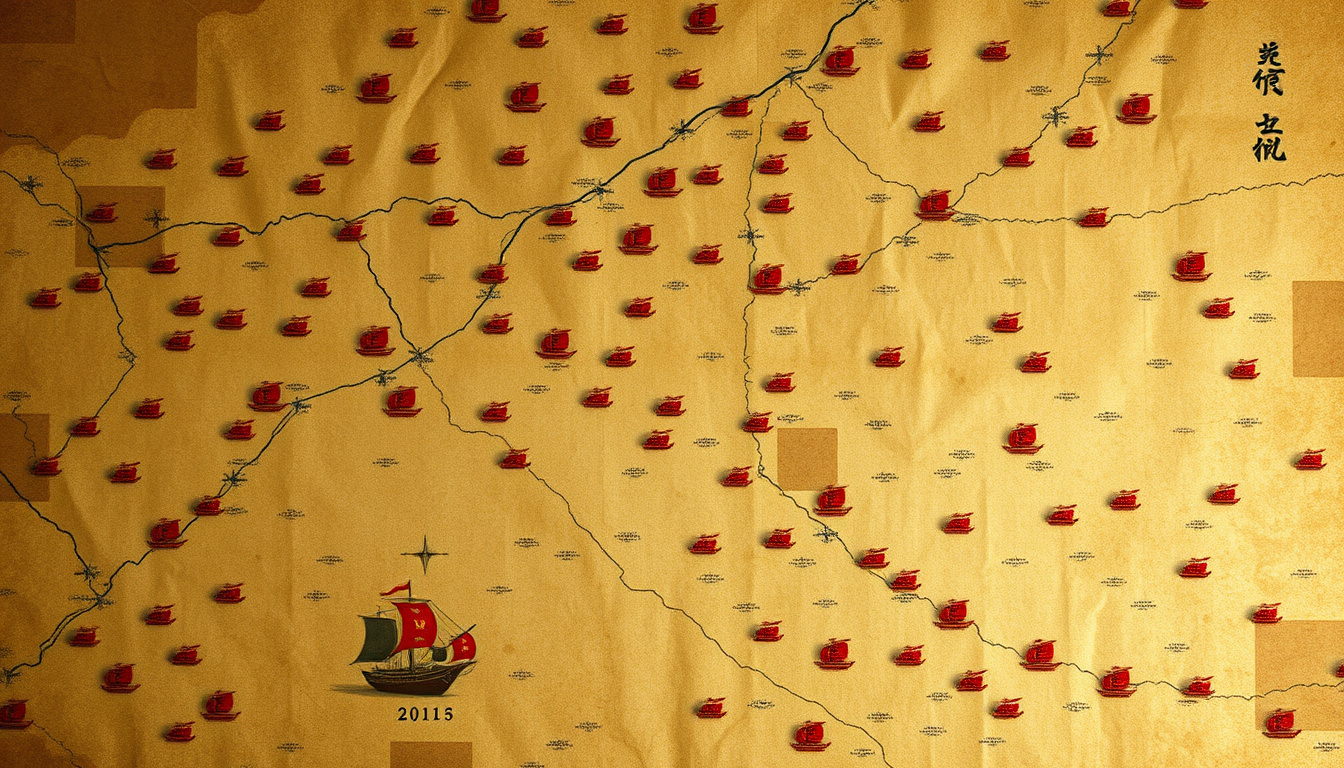
The Pirate Queen's Myth
By most tallies of ships and manpower, Ching Shih commanded the largest pirate force ever assembled — contemporary Qing estimates put her peak fleet near 1,800 vessels and 50,000 to 80,000 people, dwarfing contemporaries like Blackbeard by orders of magnitude. Her story went west through a garbled 1831 translation of a Qing-era account, then further through Philip Gosse's sensationalized 1932 pirate history, cementing — and distorting — her legend for English readers. She later inspired the fictional "Mistress Ching" in Pirates of the Caribbean: At World's End and a story by Jorge Luis Borges. Modern historians increasingly read her less as a swashbuckling outlaw and more as the administrator of a rival, floating state — a woman who out-organized empires.
The gap between the "pirate queen" of pop culture and the historical administrator is mostly a translation problem: a flawed 1831 rendering of Chinese court records introduced errors that later popular historians repeated and dramatized without returning to the original sources, letting a real bureaucratic strategist calcify into pulp legend.
Timeline
Quotes
“In their attacks they are intrepid, and in their defence most desperate, yielding in the latter instance to no superiority of numbers; the laws of discipline and civil government are equally enforced on board his junk.”
“Zhang Bao obeyed Zheng Yi Sao's orders, and consulted her on all things before acting.”
“Not the least thing shall be taken privately from the stolen and plundered goods; all shall be registered ... those who steal anything out of this general fund shall be executed.”
“Under the leadership of a man you have all chosen to flee. We shall see how you prove yourselves under the hand of a woman.”
Myths
She Wrote the Pirate Code Herself
Ching Shih personally authored the strict legal code — the death penalty for rape, the plunder-registry rules — that governed her fleet.
Modern scholarship traces the code to a garbled 1831 translation of a Qing chronicle and increasingly credits her lieutenant and second husband, Zhang Bao, as its actual author; the misattribution to Ching Shih was cemented by a sensationalized 1932 English-language pirate history.
The Brothel-to-Pirate-Queen Romance
A pirate captain fell for a beautiful prostitute, swept her off a brothel boat, and she rose to power through his affection.
No primary Chinese source confirms a romantic account of the marriage; what does survive points to a hard-negotiated, transactional partnership in which she reportedly secured equal command and an equal share of plunder as marriage conditions, not a gift from a smitten husband.
Exactly 1,800 Ships, 80,000 Pirates
Her fleet numbered a precise 1,800 ships and 80,000 pirates at its height, often repeated as hard fact.
These figures are the upper end of a wide range of contemporary Qing estimates; other period and scholarly sources put the peak closer to 400–600 ships and 40,000–70,000 people. The general claim that she commanded history's largest pirate force is well supported — the exact headcount is not.
Everyone Who Surrendered Walked Free
The 1810 amnesty was a clean, consequence-free retirement for the entire pirate confederation.
While Ching Shih and Zhang Bao personally kept their wealth, rank, and freedom, the amnesty was not blanket leniency: roughly 140 pirates judged the worst offenders were executed or banished, and thousands of ordinary crew were dispersed into farming or military service rather than enriched.
She Commanded All 80,000 Pirates Directly
Ching Shih was sole, undisputed commander of the entire Guangdong pirate confederation.
The confederation was a coalition of six semi-autonomous fleets under different colored flags, each with its own commander — Guo Podai led the Black Flag Fleet, Wu Shi'er the Blue, and so on. These allies could and did act independently; the Black Flag Fleet's commander in fact surrendered separately, months before Ching Shih's own negotiations concluded.
Network
Click a name to jump to their story below.
A pirate captain from a multigenerational piracy family, he married Shi Yang in 1801 as a full partner and, with her, formalized the six-fleet Guangdong pirate confederation in 1805 before dying in a storm in 1807.
Abducted into the Zheng family pirate operation at fifteen, he became Ching Shih's most trusted commander after Zheng Yi's death, her romantic partner, and eventually her husband under the 1810 amnesty terms; he later served as a Qing naval officer until his death in 1822.
The senior Qing official who negotiated the 1810 pirate amnesty face-to-face with Ching Shih in Canton, ultimately granting the confederation's leaders pardons, rank, and permission to keep their wealth.
Leader of the second-largest fleet in the pirate confederation, he fought alongside Ching Shih's forces through much of 1809 but negotiated his own surrender in November 1809, months ahead of and separately from hers.
An East India Company officer held captive by the Red Flag Fleet for about eleven weeks in 1809, he published a firsthand account of the pirates' discipline and daily life that remains a key Western source on the confederation.
The chief magistrate of Macau who helped broker and host negotiations between the pirate confederation and Qing officials after Portuguese warships joined the blockade against Ching Shih's fleet.
The Qing official later famous for his role in the First Opium War who, as viceroy decades after her retirement, petitioned the emperor to dismiss the elderly Ching Shih's 1840 embezzlement lawsuit.
Character
Ruthless Negotiator
Facing a costly stalemate in 1810, she walked unarmed into the Qing viceroy's headquarters with a delegation of women and children and negotiated a pardon that let her keep her ships and fortune — an outcome almost no pirate commander in history achieved.
Administrative Mind
Long before she held formal command, she is credited with building the confederation's plunder-registry and treasury systems — the bookkeeping infrastructure that let a coalition of tens of thousands of fighters function without collapsing into internal theft.
Iron Disciplinarian
Under the fleet's code, going ashore without leave meant mutilation and execution, and disobeying a superior meant beheading on the spot — rules enforced across a force many times larger than most national navies of the era.
Battle-Tested Strategist
Her forces cut the Qing provincial fleet's strength roughly in half in 1808 and broke a combined Qing-Portuguese blockade at Lantau in January 1810, escaping a sealed bay with minimal losses against European cannon.
Self-Made
She rose from an obscure, likely Tanka boat-dwelling background and work in a Canton floating brothel to command of the era's largest maritime force — a status almost impossible to reach through any conventional path open to a Qing-era woman.
Survivor by Design
Unlike nearly every major pirate commander of her generation, she died of natural causes in old age rather than in battle, execution, or exile — a direct result of the pardon and legal wealth she negotiated in 1810.
Litigious in Old Age
In her mid-sixties, decades after retiring from piracy, she formally sued a Qing government official for embezzling 28,000 taels of silver owed to her family — working the legal system as deliberately as she'd once worked the sea.
Blurred the Personal and the Political
Her relationship with Zhang Bao — her late husband's adopted son, her own lieutenant, and eventually her second husband — fused family, command, and romance into a single bond that secured her succession but scandalized contemporary observers.
Have a question this chapter didn\u2019t answer? Ask the archive \u2014 answered live, checked against the same research as the story above.