Chapter 01 1849
The first crossing
Cheryl · AI-generated narration
The advertisement called her Minty. In October 1849, a newspaper notice named three people who had escaped enslavement on Maryland’s Eastern Shore: Minty, Ben, and Harry. The woman remembered as Harriet Tubman appeared in print as someone an enslaver wanted captured and returned. The notice offered one hundred dollars for each person taken outside Maryland, fifty for each taken within it. [1, 2]
That notice records the beginning of an escape story with a false start. On September 17, Tubman had left with her brothers Ben and Henry, also called Harry. They turned back. Soon afterward she left again, this time alone, and succeeded in escaping. The date of the first departure survives; it should not be mistaken for the date she finally reached freedom. [1, 3]
The danger of sale had made the situation urgent. Edward Brodess, her enslaver, died in March 1849. Tubman feared being sold away from her family as his widow faced the estate’s debts. Three of her older sisters had already been sold south. The possibility of another separation was part of the world in which she made her decision. [4, 5]
She had been born Araminta Ross, around 1822, in Dorchester County. Her parents were Ben Ross and Harriet Green, known as Rit. By 1849 she had married John Tubman and adopted the name Harriet. The reward notice’s older nickname is one reminder that documents made by people claiming ownership preserve their own view of the people they pursued. [1, 5]
Her successful journey took her through Maryland and Delaware into Pennsylvania. She found freedom in Philadelphia. A precise itinerary for that first successful escape would promise more than these sources establish: they give us a journey and its outcome, rather than an account of every shelter, crossing, or conversation along the way. [4, 5]
Philadelphia brought contact with Black and white abolitionists who could offer support. It also left her separated from the family she had escaped being sold away from. Reaching the North had changed her circumstances while leaving people she loved in bondage. Her work as a guide would grow from that separation. [4, 5]
Over the following decade, she returned to Maryland about thirteen times and personally guided roughly seventy people to freedom. The scale is smaller than the familiar story of three hundred rescues, but every journey involved real people and repeated danger. Those she helped included relatives and friends, with assistance from networks of people resisting slavery. [1, 5]
Her first successful escape took her out of Maryland. The return journeys would help others leave enslavement behind. Before following her back, the story must return to the Eastern Shore where Minty Ross grew up—and to the family, forced labor, and knowledge of the landscape that shaped her life. [3, 5]
A note on the telling
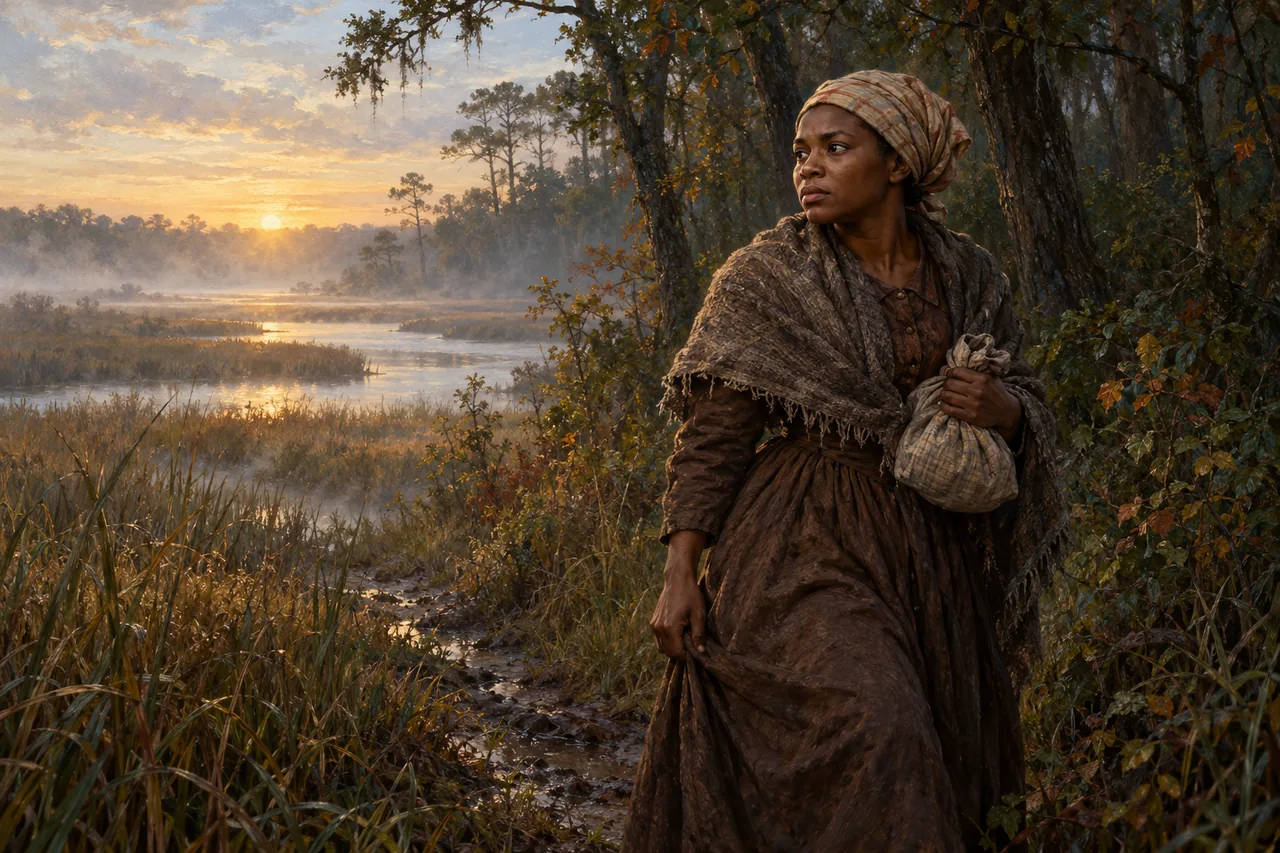
The reward notice documents the first attempt with her brothers; September 17 is not assigned to her later successful escape. The exact route, dialogue and private thoughts are not reconstructed. Rescue totals are approximate. The illustration evokes the Eastern Shore landscape and is not an archival image or a documented moment.
Read the manuscript sources