Chapter 01 1977
The work begins
Melissa Makenna · AI-generated narration
The Green Belt Movement began with needs that could be named. Rural Kenyan women reported streams drying up, less reliable food supplies, and longer journeys to gather firewood. In 1977, Wangari Maathai founded the movement under the National Council of Women of Kenya. Its starting point was the connection between damaged land and daily work. [1]
Planting trees offered a practical response: wood for fuel, food and protection for the soil. Women could organize around something they needed and could help produce. In a later interview, Maathai described how the council encouraged planting, and how the women’s initial doubts gave way to methods they could develop themselves. [2]
Maathai brought scientific training to that work. She had studied biological sciences in the United States and earned a doctorate at the University of Nairobi in 1971. She also taught veterinary anatomy. In 1977 she became an associate professor there. The environmental campaign grew alongside an academic career, through the women’s council and the concerns people brought to it. [3, 5]
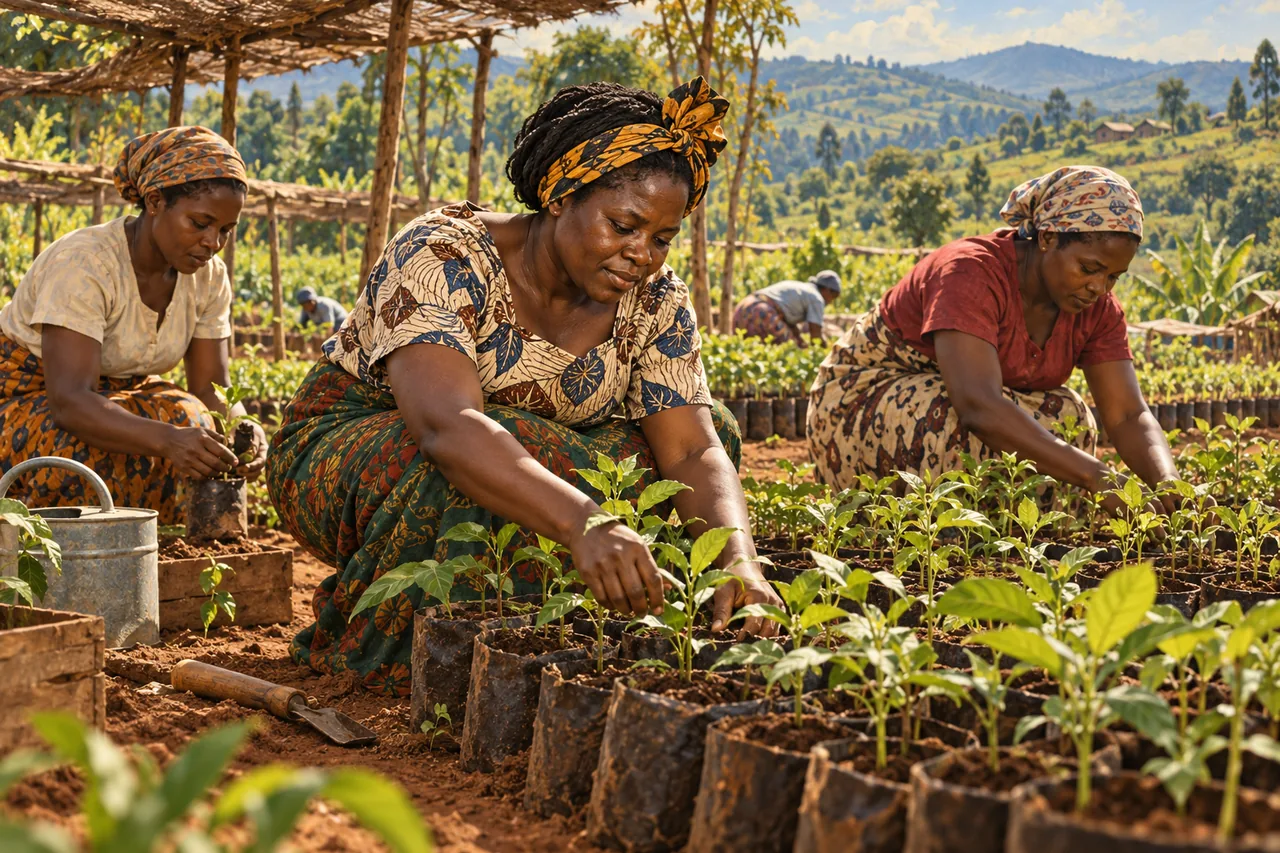
Seedlings needed people to nurture them. In her account, the women collected tree seeds and planted them using skills familiar from growing food crops. Pots filled with soil became places to raise young trees. Raising the pots helped protect the seedlings from chickens and goats. The women’s own experiments helped shape the movement’s practical methods. [2]
Such work depended on many hands. Seeds had to be gathered, seedlings tended and trees cared for after planting. The movement’s history is therefore a history of community groups as well as its founder. Maathai’s recollections give the women an active part: they observed problems, adapted techniques and brought neighbors into the effort. [2]
As the organization developed, it examined the political and social roots of poverty and environmental loss. Community education accompanied campaigns against land grabbing and forest destruction. Its work extended to defending public spaces and calling for the release of political prisoners. Planting and public participation became connected parts of a wider struggle. [1]
In 2004, Maathai became the first African woman to receive the Nobel Peace Prize. The award recognized her contribution to sustainable development, democracy and peace. That recognition came twenty-seven years after the movement’s founding. The later honor should not obscure the ordinary, repeated work that helped make it possible. [4, 5]
The beginning was a task people could take up together, with results that required care over time. It would lead Maathai and her colleagues into conflicts over forests, public land and political power. Before following those struggles, the story returns to the Kenyan highlands where she grew up, and the education that carried her abroad and home. [1, 3, 5]
A note on the telling
The founding year and National Council of Women of Kenya connection are supported by the Green Belt Movement’s institutional history. Practical nursery methods and women’s participation are paraphrased from Maathai’s later, first-person interview; no dialogue, private thoughts or exact founding ceremony is reconstructed. The narrative distinguishes the 1977 beginning from the movement’s later campaigns and the 2004 Nobel Peace Prize. Tree planting is presented as collective work, with no claim that Maathai personally planted the movement’s total. The artwork is interpretive, not archival.
Read the manuscript sources