Chapter 01 1941–1942
The name on
the patent
Mariana · AI-generated narration
On August 11, 1942, the United States Patent Office granted a patent for a secret communication system. The drawings showed a ship, a torpedo, and an arrangement for changing radio frequencies. Two inventors appeared on the document: George Antheil and Hedy Kiesler Markey. [1]
Movie audiences knew the second inventor by another name: Hedy Lamarr. She was an Austrian-born actress whose Hollywood career included Ziegfeld Girl. Antheil was a composer, with an unusual interest that would become useful to them both: the problem of keeping mechanical instruments in time. [2, 3]
Their project addressed a weakness in radio control. If an enemy found the frequency carrying instructions to a torpedo, that enemy could try to disrupt the signal. Lamarr and Antheil proposed moving the transmitter and receiver together through a sequence of frequencies. A listener who lacked the sequence would have a harder time following the conversation. [1]
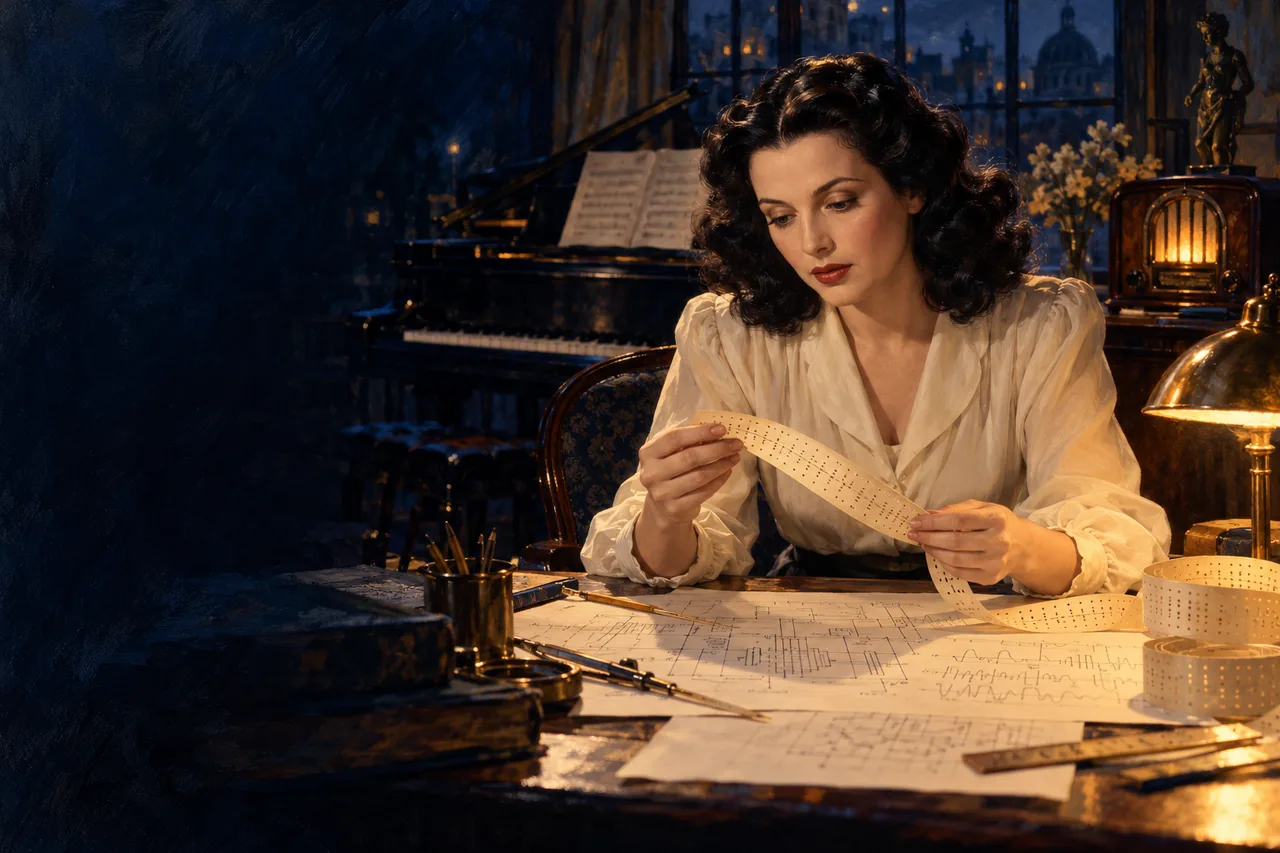
The drawings made the idea tangible. Perforated paper records, of the kind used in player pianos, would tell both ends when to change. Synchronization held the design together: a transmitter on one frequency and a receiver on another would lose contact. The paper rolls were a proposed way of keeping them together. [1]
An actress and a composer had brought different experiences to the same engineering question. Their collaboration offered a way to think about the movement of a signal through time. It also produced something concrete enough to examine: a patent application, filed on June 10, 1941, and granted the following year. [1, 3]
A patent, however, does not establish that a design reached the battlefield. The Navy declined to adopt their system. Broader recognition came much later: in 1997, the Electronic Frontier Foundation honored Lamarr and Antheil for their contribution. [3, 4]
The familiar modern headline makes Lamarr the inventor of Wi-Fi. That compresses a long, collaborative history of wireless engineering into a claim this patent cannot support. What the document does preserve is worth reading closely: two named inventors, a particular problem, and an ingenious proposed answer. [1, 2]
Before following that signal forward, it is worth following her life back—to Vienna, the screen, and the choices that brought Hedy Kiesler to Hollywood. [5]
A note on the telling
This is a documentary cold open. No dialogue, private thoughts, room details or eyewitness scene have been invented. The illustration is an AI-generated interpretation, not an archival image.
Read the manuscript sources